Pearson+ LogoPearson+ Logo
Ch.7 Chemical Quantities and Reactions
Timberlake - Chemistry: An Introduction to General, Organic, and Biological Chemistry 13th Edition
Timberlake13th EditionChemistry: An Introduction to General, Organic, and Biological ChemistryISBN: 9780134421353Not the one you use?Change textbook
Chapter 7, Problem 111b

Consider the following unbalanced equation:
Al(s) + O2(g) → Al2O3(s)
b. Identify the type of reaction.

Verified step by step guidance
1
Step 1: Observe the given chemical equation: Al(s) + O₂(g) → Al₂O₃(s). This reaction involves aluminum (Al) reacting with oxygen (O₂) to form aluminum oxide (Al₂O₃).
Step 2: Recognize that this reaction involves a single product (Al₂O₃) being formed from two reactants (Al and O₂). This is a key characteristic of a synthesis reaction.
Step 3: Recall the definition of a synthesis reaction: A synthesis reaction occurs when two or more reactants combine to form a single product. This is also sometimes referred to as a combination reaction.
Step 4: Confirm that the reaction fits the criteria for a synthesis reaction because aluminum and oxygen are combining to form a single compound, aluminum oxide.
Step 5: Conclude that the type of reaction is a synthesis reaction (or combination reaction).

Verified video answer for a similar problem:

This video solution was recommended by our tutors as helpful for the problem above.
Video duration:
1m
Was this helpful?

Key Concepts

Here are the essential concepts you must grasp in order to answer the question correctly.

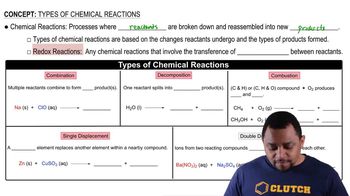
Types of Chemical Reactions

Chemical reactions can be classified into several types, including synthesis, decomposition, single replacement, and double replacement. In a synthesis reaction, two or more reactants combine to form a single product. Understanding these categories helps in identifying the nature of the reaction based on the reactants and products involved.
Recommended video:
Guided course
04:07
Types of Chemical Reactions Concept 1

Synthesis Reaction

A synthesis reaction, also known as a combination reaction, occurs when two or more substances combine to form a more complex product. In the given equation, aluminum (Al) and oxygen (O₂) react to form aluminum oxide (Al₂O₃), exemplifying a synthesis reaction where elements combine to create a compound.
Recommended video:
Guided course
1:54
Overview of Protein Synthesis Concept 1

Balancing Chemical Equations

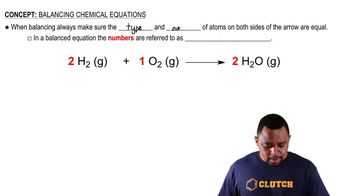
Balancing chemical equations is essential to ensure that the law of conservation of mass is upheld, meaning the number of atoms of each element must be the same on both sides of the equation. Although the provided equation is unbalanced, recognizing the need for balance is crucial for accurately representing the reaction and understanding stoichiometry.
Recommended video:
Guided course
01:32
Balancing Chemical Equations (Simplified) Concept 1