Compare the Lewis structures of CH4 and H2O Why do these molecules have similar bond angles but different molecular shapes?
Ch.6 Ionic and Molecular Compounds
Timberlake13th EditionChemistry: An Introduction to General, Organic, and Biological ChemistryISBN: 9780134421353Not the one you use?Change textbook
Chapter 6, Problem 75
Compare the Lewis structures of CF4 and NF3 Why do these molecules have different shapes?
Verified step by step guidance1
Determine the central atom for each molecule: In CF₄, the central atom is carbon (C), and in NF₃, the central atom is nitrogen (N). This is because carbon and nitrogen are less electronegative than fluorine (F), and they can form multiple bonds.
Draw the Lewis structure for CF₄: Carbon has 4 valence electrons, and each fluorine atom has 7 valence electrons. Carbon forms single bonds with each of the four fluorine atoms, using all 4 of its valence electrons. Each fluorine atom completes its octet by having 3 lone pairs of electrons.
Draw the Lewis structure for NF₃: Nitrogen has 5 valence electrons, and each fluorine atom has 7 valence electrons. Nitrogen forms single bonds with each of the three fluorine atoms, using 3 of its valence electrons. The remaining 2 valence electrons on nitrogen form a lone pair, while each fluorine atom completes its octet with 3 lone pairs.
Analyze the molecular geometry of CF₄: The central carbon atom in CF₄ has 4 bonding pairs and no lone pairs. According to VSEPR (Valence Shell Electron Pair Repulsion) theory, the electron pairs arrange themselves as far apart as possible, resulting in a tetrahedral shape.
Analyze the molecular geometry of NF₃: The central nitrogen atom in NF₃ has 3 bonding pairs and 1 lone pair. The lone pair exerts greater repulsion than bonding pairs, causing the molecule to adopt a trigonal pyramidal shape instead of a tetrahedral shape.

Verified video answer for a similar problem:
This video solution was recommended by our tutors as helpful for the problem above.
Video duration:
8mWas this helpful?
Key Concepts
Here are the essential concepts you must grasp in order to answer the question correctly.
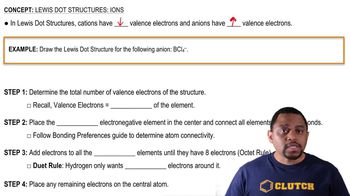
Lewis Structures
Lewis structures are diagrams that represent the bonding between atoms in a molecule and the lone pairs of electrons that may exist. They help visualize the arrangement of valence electrons and the connectivity of atoms, which is crucial for predicting molecular geometry and reactivity. In the case of CF₄ and NF₃, their Lewis structures reveal the number of bonds and lone pairs, which influence their shapes.
Recommended video:
Guided course
Lewis Dot Structures: Ions (Simplified) Concept 1
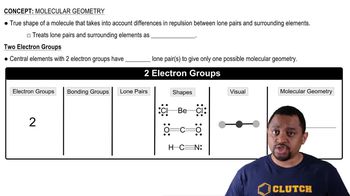
Molecular Geometry
Molecular geometry refers to the three-dimensional arrangement of atoms within a molecule. It is determined by the number of bonding pairs and lone pairs of electrons around the central atom, as described by the VSEPR (Valence Shell Electron Pair Repulsion) theory. CF₄ has a tetrahedral shape due to four bonding pairs and no lone pairs, while NF₃ has a trigonal pyramidal shape because of three bonding pairs and one lone pair.
Recommended video:
Guided course
Molecular Geometry (Simplified) Concept 1
VSEPR Theory
VSEPR theory is a model used to predict the geometry of individual molecules based on the repulsion between electron pairs. According to this theory, electron pairs will arrange themselves to minimize repulsion, leading to specific molecular shapes. This theory explains why CF₄ adopts a tetrahedral shape and NF₃ takes on a trigonal pyramidal shape, as the presence of lone pairs alters the spatial arrangement of the bonding pairs.
Recommended video:
Guided course
Atomic Theory
Related Practice
Textbook Question
1821
views
Textbook Question
Complete each of the following statements for a molecule of H2S:
c. The number of atoms attached to the central S atom is _______.
1428
views
Textbook Question
Why is CCl4 a nonpolar molecule, but is PCl3 a polar molecule?
1007
views
Textbook Question
Choose the shape (1 to 6) that matches each of the following descriptions (a to c):
1. linear
2. bent (109°)
3. trigonal planar
4. bent (120°)
5. trigonal pyramidal
6. tetrahedral
b. a molecule with a central atom that has four electron groups and three bonded atoms
1822
views
Textbook Question
Identify the major type of intermolecular forces between the particles of each of the following:
b. MgF2
884
views
Textbook Question
For each of the following bonds, indicate the positive end with 𝛿⁺ and the negative end with 𝛿⁻ . Draw an arrow to show the dipole for each.
a. N and F
1834
views