Pearson+ LogoPearson+ Logo
Ch.6 Ionic and Molecular Compounds
Timberlake - Chemistry: An Introduction to General, Organic, and Biological Chemistry 13th Edition
Timberlake13th EditionChemistry: An Introduction to General, Organic, and Biological ChemistryISBN: 9780134421353Not the one you use?Change textbook
Chapter 6, Problem 71b

Choose the shape (1 to 6) that matches each of the following descriptions (a to c):
1. linear
2. bent (109°)
3. trigonal planar
4. bent (120°)
5. trigonal pyramidal
6. tetrahedral
b. a molecule with a central atom that has four electron groups and three bonded atoms

Verified step by step guidance
1
Step 1: Understand the concept of electron groups. Electron groups include bonded atoms (single, double, or triple bonds count as one group) and lone pairs of electrons around the central atom.
Step 2: Recognize that the problem specifies four electron groups around the central atom. This indicates the molecule is based on a tetrahedral electron geometry.
Step 3: Note that the central atom has three bonded atoms and one lone pair. The presence of a lone pair modifies the molecular shape from the ideal tetrahedral geometry.
Step 4: Recall that when there are three bonded atoms and one lone pair, the molecular shape is described as 'trigonal pyramidal.' This is because the lone pair repels the bonded atoms, creating a three-sided pyramid-like structure.
Step 5: Match the description to the provided options. The correct shape for a molecule with four electron groups, three bonded atoms, and one lone pair is 'trigonal pyramidal,' which corresponds to option 5.

Verified video answer for a similar problem:

This video solution was recommended by our tutors as helpful for the problem above.
Video duration:
4m
Was this helpful?

Key Concepts

Here are the essential concepts you must grasp in order to answer the question correctly.

Electron Groups

Electron groups refer to regions of electron density around a central atom in a molecule. These can include lone pairs, single bonds, double bonds, or triple bonds. The number of electron groups determines the molecular geometry, as they repel each other and arrange themselves to minimize repulsion.
Recommended video:
Guided course
2:26
Alkyl Groups Concept 1

Molecular Geometry

Molecular geometry describes the three-dimensional arrangement of atoms in a molecule. It is influenced by the number of electron groups around the central atom and their spatial orientation. Understanding molecular geometry is crucial for predicting the shape and reactivity of molecules.
Recommended video:
Guided course
01:30
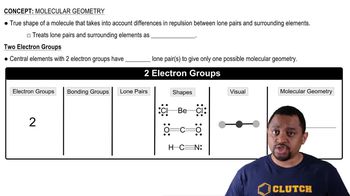
Molecular Geometry (Simplified) Concept 1

Trigonal Pyramidal Shape

A trigonal pyramidal shape occurs when a central atom is bonded to three other atoms and has one lone pair of electrons. This arrangement results in a pyramid-like structure with the bonded atoms at the base and the lone pair at the apex, leading to bond angles that are typically less than 109.5°.
Recommended video:
Guided course
2:05
Alpha Helix Spiral Shape Concept 3