How does the double bond influence the dispersion forces that can form between the hydrocarbon chains of fatty acids?
Verified step by step guidance
1
Understand the concept of dispersion forces: Dispersion forces, also known as London dispersion forces, are weak intermolecular forces that arise due to temporary dipoles created when electrons move around atoms or molecules. These forces are stronger when molecules can pack closely together.
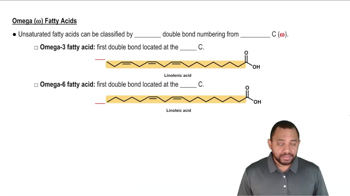
Recognize the role of double bonds in fatty acids: A double bond in a hydrocarbon chain introduces a region of unsaturation, which creates a kink or bend in the chain. This structural change prevents the chains from aligning closely with one another.
Analyze the impact of the kink: The kink caused by the double bond reduces the surface area of contact between adjacent fatty acid chains. This decreased contact area weakens the dispersion forces because the molecules cannot pack as tightly.
Compare saturated and unsaturated fatty acids: Saturated fatty acids, which lack double bonds, have straight chains that can pack closely together, leading to stronger dispersion forces. In contrast, unsaturated fatty acids with double bonds have bent chains, resulting in weaker dispersion forces.
Conclude the influence of double bonds: The presence of double bonds in fatty acids disrupts the alignment of hydrocarbon chains, reducing the strength of dispersion forces and lowering the melting point of the fatty acid. This is why unsaturated fats are typically liquid at room temperature, while saturated fats are solid.
Verified video answer for a similar problem:
This video solution was recommended by our tutors as helpful for the problem above
Video duration:
2m
Play a video:
Was this helpful?
Key Concepts
Here are the essential concepts you must grasp in order to answer the question correctly.
Double Bonds in Fatty Acids
Double bonds in fatty acids create kinks in the hydrocarbon chains, preventing them from packing closely together. This structural change affects the physical properties of the fatty acids, such as their melting points and fluidity. Unsaturated fatty acids, which contain double bonds, are typically liquid at room temperature, while saturated fatty acids, which have only single bonds, are solid.
Dispersion forces, also known as London dispersion forces, are weak intermolecular forces that arise from temporary fluctuations in electron density within molecules. These forces are present in all molecules, but they are particularly significant in nonpolar substances like hydrocarbons. The strength of dispersion forces increases with the size and surface area of the molecules, influencing their physical properties.
Hydrocarbon chains are long sequences of carbon and hydrogen atoms that form the backbone of fatty acids. The length and saturation of these chains affect their interactions with each other, including the strength of dispersion forces. Longer chains with more surface area can enhance these forces, while the presence of double bonds can disrupt the packing of the chains, thereby altering the overall intermolecular interactions.