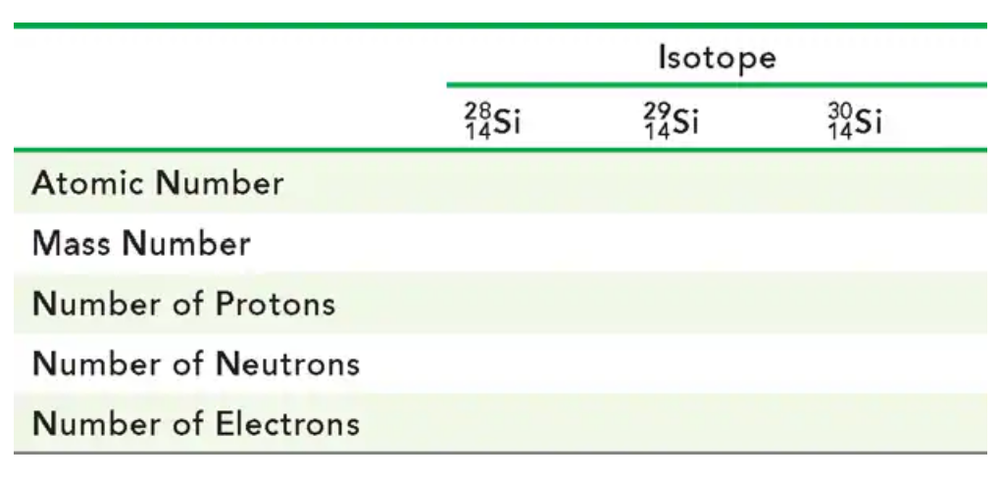
Complete the following table for the three naturally occurring isotopes of silicon, the major component in computer chips:
Verified step by step guidance
1
Step 1: Understand the isotopic symbol format. The isotopic symbol is written as \( ^{A}_{Z}X \), where \( A \) is the mass number (sum of protons and neutrons), \( Z \) is the atomic number (number of protons), and \( X \) is the chemical symbol of the element.
Step 2: Identify the atomic number \( Z \) for silicon. Silicon has an atomic number of 14, meaning it has 14 protons.
Step 3: Determine the mass number \( A \) for each isotope. The three naturally occurring isotopes of silicon are \( ^{28}_{14}Si \), \( ^{29}_{14}Si \), and \( ^{30}_{14}Si \). The mass number is the sum of protons and neutrons.
Step 4: Calculate the number of neutrons for each isotope. Subtract the atomic number \( Z \) from the mass number \( A \): \( \text{Number of neutrons} = A - Z \). For example, \( ^{28}_{14}Si \) has \( 28 - 14 = 14 \) neutrons.
Step 5: Determine the number of electrons. In a neutral atom, the number of electrons equals the number of protons. For silicon isotopes, the number of electrons is 14.
Verified video answer for a similar problem:
This video solution was recommended by our tutors as helpful for the problem above
Video duration:
2m
Play a video:
Was this helpful?
Key Concepts
Here are the essential concepts you must grasp in order to answer the question correctly.
Isotopes
Isotopes are variants of a chemical element that have the same number of protons but different numbers of neutrons. This results in different mass numbers for the isotopes. For example, silicon has three naturally occurring isotopes: Si-28, Si-29, and Si-30, each differing in neutron count while maintaining the same atomic number of 14.
The atomic number is the number of protons found in the nucleus of an atom and defines the element. For silicon, the atomic number is 14, meaning all silicon isotopes have 14 protons. This number is crucial for determining the element's identity and its position on the periodic table.
The mass number is the total number of protons and neutrons in an atom's nucleus. It is used to distinguish between different isotopes of an element. For instance, the mass numbers of silicon isotopes are 28, 29, and 30, reflecting their varying neutron counts while maintaining the same atomic number.