Pearson+ LogoPearson+ Logo
Ch.4 Atoms and Elements
Timberlake - Chemistry: An Introduction to General, Organic, and Biological Chemistry 13th Edition
Timberlake13th EditionChemistry: An Introduction to General, Organic, and Biological ChemistryISBN: 9780134421353Not the one you use?Change textbook
Chapter 4, Problem 83c

Indicate if the atoms in each pair have the same number of protons, neutrons, or electrons.
c. 4018Ar, 3917Cl

Verified step by step guidance
1
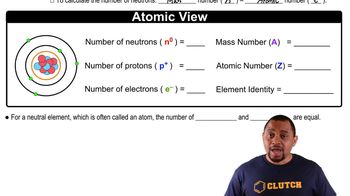
Step 1: Identify the number of protons in each atom. The number of protons is equal to the atomic number (subscript). For ⁴⁰₁₈Ar, the atomic number is 18, so it has 18 protons. For ³⁹₁₇Cl, the atomic number is 17, so it has 17 protons.
Step 2: Determine the number of neutrons in each atom. The number of neutrons is calculated by subtracting the atomic number (protons) from the mass number (superscript). For ⁴⁰₁₈Ar, neutrons = 40 - 18 = 22. For ³⁹₁₇Cl, neutrons = 39 - 17 = 22.
Step 3: Identify the number of electrons in each atom. For neutral atoms, the number of electrons is equal to the number of protons. For ⁴⁰₁₈Ar, it has 18 electrons. For ³⁹₁₇Cl, it has 17 electrons.
Step 4: Compare the number of protons, neutrons, and electrons between the two atoms. ⁴⁰₁₈Ar and ³⁹₁₇Cl have different numbers of protons (18 vs. 17) and electrons (18 vs. 17), but they have the same number of neutrons (22).
Step 5: Conclude that the atoms in the pair have the same number of neutrons but differ in the number of protons and electrons.

Verified video answer for a similar problem:

This video solution was recommended by our tutors as helpful for the problem above.
Video duration:
3m
Was this helpful?

Key Concepts

Here are the essential concepts you must grasp in order to answer the question correctly.

Atomic Structure

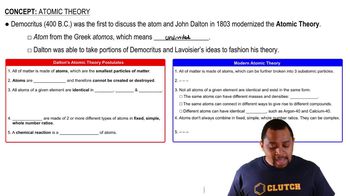
Atoms are composed of protons, neutrons, and electrons. Protons are positively charged particles found in the nucleus, while neutrons are neutral particles also located in the nucleus. Electrons are negatively charged and orbit the nucleus. The number of protons defines the element, while the number of neutrons can vary, leading to different isotopes.
Recommended video:
Guided course
05:22
Atomic Theory

Isotopes

Isotopes are variants of a particular chemical element that have the same number of protons but different numbers of neutrons. This difference in neutron count results in varying atomic masses. For example, the isotopes of argon and chlorine in the question have different neutron counts, which affects their stability and nuclear properties.
Recommended video:

Ionic and Neutral Atoms

Neutral atoms have an equal number of protons and electrons, resulting in no overall charge. In contrast, ions are charged particles that occur when an atom gains or loses electrons. Understanding whether the atoms in the pairs are neutral or ionic is crucial for determining their electron counts and comparing them accurately.
Recommended video:
Guided course
04:14
Atomic, Ionic and Molecular Solids Concept 1