Pearson+ LogoPearson+ Logo
Ch.4 Atoms and Elements
Timberlake - Chemistry: An Introduction to General, Organic, and Biological Chemistry 13th Edition
Timberlake13th EditionChemistry: An Introduction to General, Organic, and Biological ChemistryISBN: 9780134421353Not the one you use?Change textbook
Chapter 4, Problem 81d

Consider the following atoms in which X represents the chemical symbol of the element:
168X 169X 1810X 178X 188X
d. What atoms have the same number of neutrons?

Verified step by step guidance
1
Step 1: Recall that the number of neutrons in an atom can be calculated using the formula: n=A-Z, where A is the mass number (superscript) and Z is the atomic number (subscript).
Step 2: For each atom, calculate the number of neutrons using the formula. For example, for ¹⁶X, the number of neutrons is 16-8.
Step 3: Repeat the calculation for each atom: ¹⁶X, ¹⁸₁₀X, ¹⁷X, and ¹⁸X.
Step 4: Compare the calculated number of neutrons for each atom to identify which atoms have the same number of neutrons.
Step 5: Group the atoms with the same number of neutrons together and note the results. For example, if two atoms have the same neutron count, they belong to the same group.

Verified video answer for a similar problem:

This video solution was recommended by our tutors as helpful for the problem above.
Video duration:
7m
Was this helpful?

Key Concepts

Here are the essential concepts you must grasp in order to answer the question correctly.

Atomic Structure

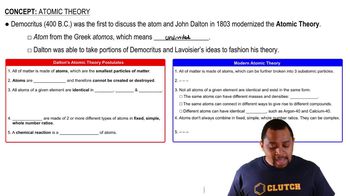
Atoms consist of protons, neutrons, and electrons. The atomic number, represented by the subscript in the notation, indicates the number of protons, while the mass number, shown as a superscript, is the total number of protons and neutrons. Understanding atomic structure is essential for determining the number of neutrons in an atom.
Recommended video:
Guided course
05:22
Atomic Theory

Neutrons

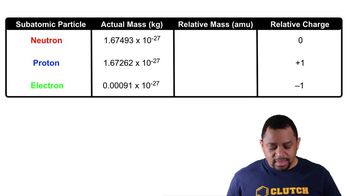
Neutrons are neutral particles found in the nucleus of an atom. The number of neutrons can be calculated by subtracting the atomic number from the mass number. Identifying atoms with the same number of neutrons involves comparing their mass numbers, as atoms with different atomic numbers can still have the same neutron count.
Recommended video:
Guided course
02:36
Subatomic Particles (Simplified) Concept 2

Isotopes

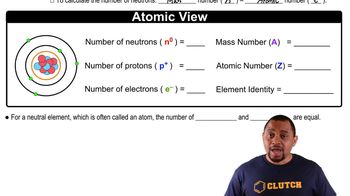
Isotopes are variants of a chemical element that have the same number of protons but different numbers of neutrons. This concept is crucial for understanding the question, as it allows for the identification of atoms that share the same neutron count despite differing in mass number. Recognizing isotopes helps in categorizing the given atoms based on their neutron composition.
Recommended video: