Pearson+ LogoPearson+ Logo
Ch.10 Acids and Bases and Equilibrium
Timberlake - Chemistry: An Introduction to General, Organic, and Biological Chemistry 13th Edition
Timberlake13th EditionChemistry: An Introduction to General, Organic, and Biological ChemistryISBN: 9780134421353Not the one you use?Change textbook
Chapter 10, Problem 7a

Identify the reactant that is a Brønsted–Lowry acid and the reactant that is a Brønsted–Lowry base in each of the following:
a. HI(aq) + H2O(l) → I-(aq) + H3O+(aq)

Verified step by step guidance
1
Step 1: Recall the definition of a Brønsted–Lowry acid and base. A Brønsted–Lowry acid is a substance that donates a proton (H⁺), while a Brønsted–Lowry base is a substance that accepts a proton (H⁺).
Step 2: Analyze the reactants in the given reaction: HI(aq) and H₂O(l). Determine which reactant donates a proton and which one accepts it.
Step 3: Observe that HI(aq) donates a proton (H⁺) to H₂O(l), forming I⁻(aq) and H₃O⁺(aq). This indicates that HI(aq) is the Brønsted–Lowry acid because it donates the proton.
Step 4: Recognize that H₂O(l) accepts the proton (H⁺) from HI(aq), forming H₃O⁺(aq). This indicates that H₂O(l) is the Brønsted–Lowry base because it accepts the proton.
Step 5: Conclude that in this reaction, HI(aq) is the Brønsted–Lowry acid, and H₂O(l) is the Brønsted–Lowry base.

Verified video answer for a similar problem:

This video solution was recommended by our tutors as helpful for the problem above.
Video duration:
46s
Was this helpful?

Key Concepts

Here are the essential concepts you must grasp in order to answer the question correctly.

Brønsted–Lowry Acid

A Brønsted–Lowry acid is defined as a substance that donates a proton (H⁺) to another substance in a chemical reaction. In the given reaction, HI (hydroiodic acid) donates a proton to water, thus acting as the acid. This concept is fundamental in understanding acid-base reactions and their mechanisms.
Recommended video:
Guided course
02:56
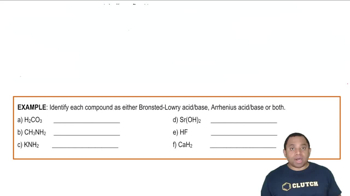
Acid-Base Classification Example

Brønsted–Lowry Base

A Brønsted–Lowry base is a substance that accepts a proton in a chemical reaction. In the provided equation, water (H₂O) accepts a proton from HI, transforming into the hydronium ion (H₃O⁺). Recognizing the role of bases in proton transfer is crucial for analyzing acid-base reactions.
Recommended video:
Guided course
02:56
Acid-Base Classification Example

Proton Transfer Reaction

A proton transfer reaction is a type of chemical reaction where a proton is transferred from an acid to a base. This process is central to the Brønsted–Lowry theory of acids and bases, as it highlights the dynamic nature of acid-base interactions. Understanding this concept helps in predicting the products of such reactions and their implications in various chemical contexts.
Recommended video:
Guided course
01:53
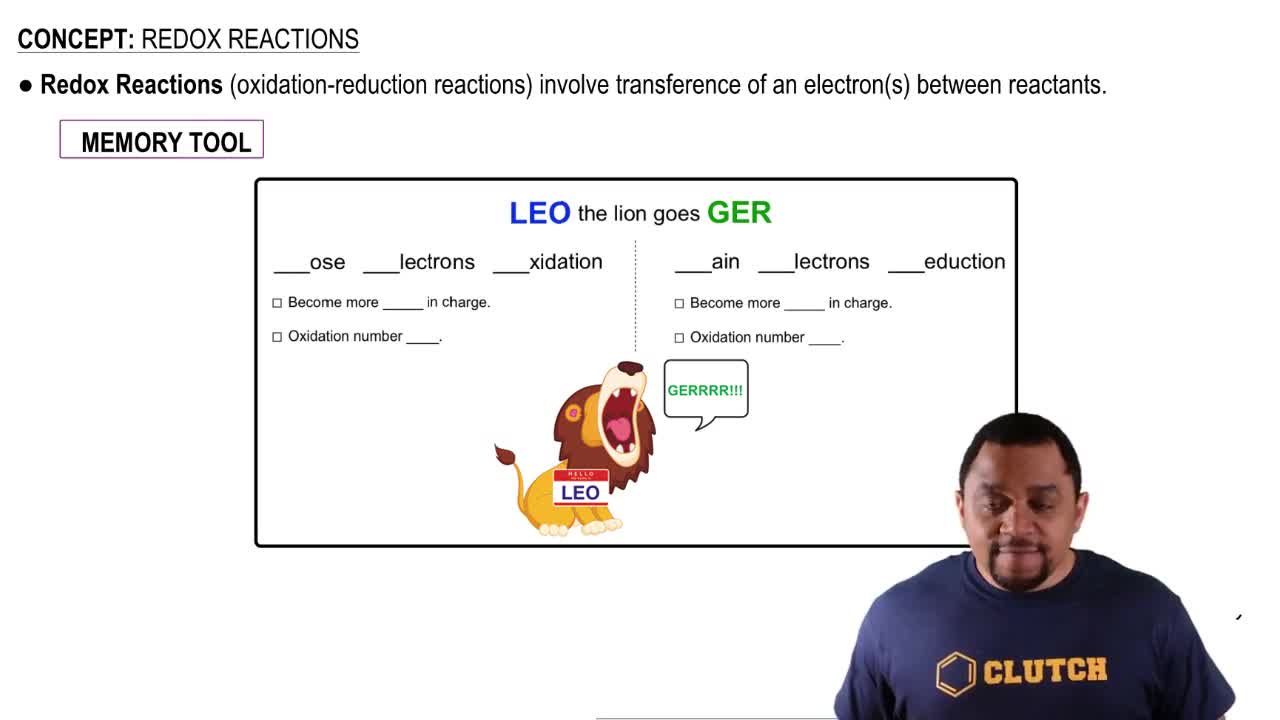
Redox Reactions