
Pearson+ LogoPearson+ Logo
Ch.2 Chemistry and Measurements
Timberlake - Chemistry: An Introduction to General, Organic, and Biological Chemistry 13th Edition
Timberlake13th EditionChemistry: An Introduction to General, Organic, and Biological ChemistryISBN: 9780134421353Not the one you use?Change textbook
Chapter 2, Problem 61c

Solve each of the following problems using one or more conversion factors:
c. An athlete has 15% body fat by mass. What is the weight of fat, in pounds, of a 74-kg athlete?

Verified step by step guidance
1
Step 1: Understand the problem. The athlete has 15% body fat by mass, and their total mass is 74 kg. We need to calculate the weight of fat in pounds. This involves converting the percentage to mass in kilograms and then converting kilograms to pounds.
Step 2: Calculate the mass of fat in kilograms. Use the percentage formula: \( \text{Mass of fat (kg)} = \text{Total mass (kg)} \times \frac{\text{Percentage of fat}}{100} \). Substitute the values: \( \text{Mass of fat (kg)} = 74 \times \frac{15}{100} \).
Step 3: Convert the mass of fat from kilograms to pounds. Use the conversion factor: \( 1 \, \text{kg} = 2.20462 \, \text{lb} \). The formula is \( \text{Mass of fat (lb)} = \text{Mass of fat (kg)} \times 2.20462 \).
Step 4: Perform the unit conversion carefully, ensuring that the kilograms cancel out and the result is in pounds.
Step 5: Verify the calculation by checking the units and ensuring the conversion factor was applied correctly. The final result will be the weight of fat in pounds.

Verified video answer for a similar problem:

This video solution was recommended by our tutors as helpful for the problem above.
Video duration:
1m
Was this helpful?

Key Concepts

Here are the essential concepts you must grasp in order to answer the question correctly.

Body Fat Percentage

Body fat percentage is a measure of the amount of fat in a person's body relative to their total body mass. It is expressed as a percentage and is crucial for understanding an individual's fitness level and health. In this context, the athlete's body fat percentage indicates that 15% of their total mass is composed of fat.
Recommended video:
Guided course
1:41
Ketone Bodies Example 1

Mass to Weight Conversion

Mass and weight are related but distinct concepts; mass is the amount of matter in an object, while weight is the force exerted by gravity on that mass. To convert mass (in kilograms) to weight (in pounds), a conversion factor is used, where 1 kg is approximately equal to 2.20462 pounds. This conversion is essential for solving the problem as it requires the final answer in pounds.
Recommended video:
Guided course
03:45
Conversion Factors (Simplified) Example 2

Conversion Factors

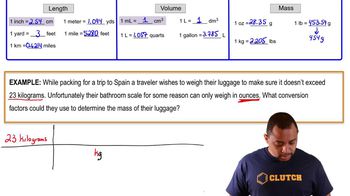
Conversion factors are ratios that express how one unit of measurement relates to another. They are used to convert quantities from one unit to another, ensuring that calculations yield results in the desired units. In this problem, conversion factors will be applied to calculate the weight of fat in pounds based on the athlete's mass and body fat percentage.
Recommended video:
Guided course
03:45
Conversion Factors (Simplified) Example 2