Pearson+ LogoPearson+ Logo
Ch.6 Ionic and Molecular Compounds
Timberlake - Chemistry: An Introduction to General, Organic, and Biological Chemistry 13th Edition
Timberlake13th EditionChemistry: An Introduction to General, Organic, and Biological ChemistryISBN: 9780134421353Not the one you use?Change textbook
Chapter 6, Problem 135a

Calculate the electronegativity difference and classify each of the following bonds as nonpolar covalent, polar covalent, or ionic:
a. Si and Cl

Verified step by step guidance
1
Determine the electronegativity values for silicon (Si) and chlorine (Cl) using the periodic table or a reliable source. For example, the electronegativity of Si is approximately 1.90, and for Cl, it is approximately 3.16.
Calculate the electronegativity difference (ΔEN) by subtracting the smaller electronegativity value from the larger one: ΔEN = |EN(Cl) - EN(Si)|. Use the formula: |EN(Cl)-EN(Si)|.
Compare the calculated ΔEN to the standard ranges for bond classification: - Nonpolar covalent: ΔEN ≈ 0 to 0.4 - Polar covalent: ΔEN ≈ 0.5 to 1.9 - Ionic: ΔEN ≥ 2.0.
Based on the calculated ΔEN, determine whether the bond between Si and Cl is nonpolar covalent, polar covalent, or ionic.
Conclude the classification of the bond and explain the reasoning. For example, if ΔEN falls in the polar covalent range, the bond is polar covalent because the electrons are shared unequally, with Cl attracting the shared electrons more strongly than Si.

Verified video answer for a similar problem:

This video solution was recommended by our tutors as helpful for the problem above.
Video duration:
1m
Was this helpful?

Key Concepts

Here are the essential concepts you must grasp in order to answer the question correctly.

Electronegativity

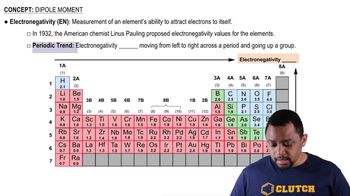
Electronegativity is a measure of an atom's ability to attract and hold onto electrons in a chemical bond. It is a key factor in determining the nature of the bond formed between two atoms. The higher the electronegativity value, the stronger the atom's pull on electrons. This concept is essential for classifying bonds as nonpolar covalent, polar covalent, or ionic based on the difference in electronegativity between the bonded atoms.
Recommended video:
Guided course
01:51
Dipole Moment (Simplified) Concept 1

Bond Classification

Bonds can be classified into three main types based on the electronegativity difference between the two atoms involved. Nonpolar covalent bonds occur when the difference is negligible (typically less than 0.4), polar covalent bonds form with a moderate difference (0.4 to 1.7), and ionic bonds arise when the difference is significant (greater than 1.7). Understanding these classifications helps predict the properties and behaviors of compounds.
Recommended video:
Guided course
04:19
Classification of Matter

Electronegativity Difference Calculation

To classify a bond, one must first calculate the electronegativity difference between the two atoms. This is done by subtracting the electronegativity value of one atom from that of the other. For example, silicon (Si) has an electronegativity of about 1.90, while chlorine (Cl) has a value of approximately 3.16. The resulting difference helps determine the bond type, guiding the analysis of the bond's characteristics.
Recommended video:
Guided course
03:13
Calculate Oxidation Numbers