Pearson+ LogoPearson+ Logo
Ch.14 Carboxylic Acids, Esters, Amines, and Amides
Timberlake - Chemistry: An Introduction to General, Organic, and Biological Chemistry 13th Edition
Timberlake13th EditionChemistry: An Introduction to General, Organic, and Biological ChemistryISBN: 9780134421353Not the one you use?Change textbook
Chapter 14, Problem 52b

Methyl benzoate, which smells like pineapple guava, is used to train detection dogs.
b. Write the IUPAC name for the carboxylic acid and alcohol used to prepare methyl benzoate.
<IMAGE>

Verified step by step guidance
1
Identify the structure of methyl benzoate. Methyl benzoate is an ester with the general formula RCOOR', where R is a benzene ring (from benzoic acid) and R' is a methyl group (from methanol).
Recall that esters are formed through a reaction between a carboxylic acid and an alcohol. In this case, the ester methyl benzoate is formed from benzoic acid and methanol.
Determine the IUPAC name of the carboxylic acid. The carboxylic acid used is benzoic acid, which has a benzene ring attached to a carboxyl group (-COOH). Its IUPAC name is 'benzoic acid.'
Determine the IUPAC name of the alcohol. The alcohol used is methanol, which consists of a single carbon atom bonded to a hydroxyl group (-OH). Its IUPAC name is 'methanol.'
Combine the information: The IUPAC names of the carboxylic acid and alcohol used to prepare methyl benzoate are 'benzoic acid' and 'methanol,' respectively.

Verified video answer for a similar problem:

This video solution was recommended by our tutors as helpful for the problem above.
Video duration:
2m
Was this helpful?

Key Concepts

Here are the essential concepts you must grasp in order to answer the question correctly.

IUPAC Nomenclature

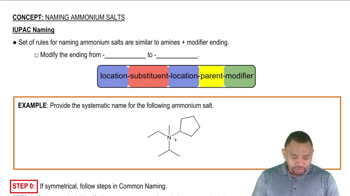
IUPAC nomenclature is a systematic method for naming chemical compounds. It provides a unique name for each compound based on its structure, ensuring clarity and consistency in communication among chemists. Understanding the rules of IUPAC nomenclature is essential for identifying the correct names of functional groups, such as carboxylic acids and alcohols, which are involved in the formation of esters like methyl benzoate.
Recommended video:
Guided course
3:18
IUPAC Naming Concept 3

Carboxylic Acids

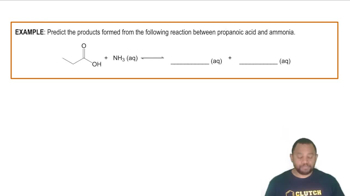
Carboxylic acids are organic compounds characterized by the presence of a carboxyl group (-COOH). They are known for their acidic properties and are commonly found in various natural and synthetic substances. In the context of methyl benzoate, the carboxylic acid involved is benzoic acid, which contributes to the esterification process that forms the compound.
Recommended video:
Guided course
1:09
Carboxylic Acid Reactions Example 1

Esterification

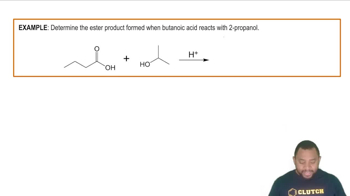
Esterification is a chemical reaction that forms an ester from an alcohol and a carboxylic acid, typically through a condensation reaction that releases water. This process is crucial in organic chemistry for synthesizing esters, which have distinct aromas and flavors. Methyl benzoate is formed by the esterification of benzoic acid and methanol, highlighting the importance of both reactants in the reaction.
Recommended video:
Guided course
0:46
Ester Reactions: Esterification Example 1