Pearson+ LogoPearson+ Logo
Ch.18 Metabolic Pathways and ATP Production
Timberlake - Chemistry: An Introduction to General, Organic, and Biological Chemistry 13th Edition
Timberlake13th EditionChemistry: An Introduction to General, Organic, and Biological ChemistryISBN: 9780134421353Not the one you use?Change textbook
Chapter 18, Problem 84

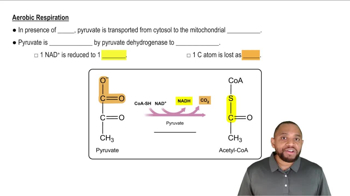
When pyruvate is used to form acetyl CoA, the product has only two carbon atoms. What happened to the third carbon?

Verified step by step guidance
1
Understand the context: Pyruvate is a three-carbon molecule that undergoes a process called oxidative decarboxylation to form acetyl CoA, which is a two-carbon molecule. This reaction is catalyzed by the pyruvate dehydrogenase complex.
Recognize the key chemical change: During the conversion of pyruvate to acetyl CoA, one carbon atom is removed from pyruvate in the form of carbon dioxide (CO₂). This is why acetyl CoA has only two carbon atoms.
Identify the role of decarboxylation: The removal of the carbon atom as CO₂ is an example of a decarboxylation reaction, which is a common type of reaction in metabolic pathways.
Understand the fate of the third carbon: The carbon atom that is removed as CO₂ is released as a waste product during cellular respiration. This CO₂ can eventually be exhaled by the organism.
Connect to the bigger picture: This reaction is a critical step in the metabolic pathway, as acetyl CoA enters the citric acid cycle (Krebs cycle) to further produce energy in the form of ATP.

Verified video answer for a similar problem:

This video solution was recommended by our tutors as helpful for the problem above.
Video duration:
3m
Was this helpful?

Key Concepts

Here are the essential concepts you must grasp in order to answer the question correctly.

Pyruvate Decarboxylation

Pyruvate decarboxylation is a crucial metabolic process that occurs in the mitochondria, where pyruvate, a three-carbon compound derived from glucose, is converted into acetyl CoA, a two-carbon molecule. During this reaction, one carbon atom is removed from pyruvate in the form of carbon dioxide (CO2), which is released as a byproduct. This step is essential for linking glycolysis to the citric acid cycle.
Recommended video:
Guided course
1:38
Pyruvate Oxidation Concept 2

Acetyl CoA

Acetyl CoA is a central metabolite in cellular respiration, formed from the decarboxylation of pyruvate. It serves as a key substrate for the citric acid cycle, where it combines with oxaloacetate to form citrate, initiating a series of reactions that produce energy. Acetyl CoA is also involved in fatty acid synthesis and other metabolic pathways, highlighting its importance in energy metabolism.
Recommended video:
Guided course
1:33
Phase B - Succinyl CoA Formation Example 2

Carbon Loss in Metabolism

The loss of carbon during metabolic processes, such as the conversion of pyruvate to acetyl CoA, is a common occurrence in cellular respiration. This loss typically manifests as carbon dioxide, which is a waste product of aerobic respiration. Understanding this concept is vital for grasping how organisms convert food into energy while also regulating carbon balance in biological systems.
Recommended video:
Guided course
0:52
Metabolic Pathways Concept 2