
Pearson+ LogoPearson+ Logo
Ch.2 Chemistry and Measurements
Timberlake - Chemistry: An Introduction to General, Organic, and Biological Chemistry 13th Edition
Timberlake13th EditionChemistry: An Introduction to General, Organic, and Biological ChemistryISBN: 9780134421353Not the one you use?Change textbook
Chapter 2, Problem 67c

Determine the density (g/mL) for each of the following:
c. A gem has a mass of 4.50 g. When the gem is placed in a graduated cylinder containing 12.00 mL of water, the water level rises to 13.45 mL.

Verified step by step guidance
1
Step 1: Recall the formula for density, which is \( \text{Density} = \frac{\text{Mass}}{\text{Volume}} \). This formula relates the mass of an object to the volume it occupies.
Step 2: Identify the mass of the gem from the problem. The mass is given as 4.50 g.
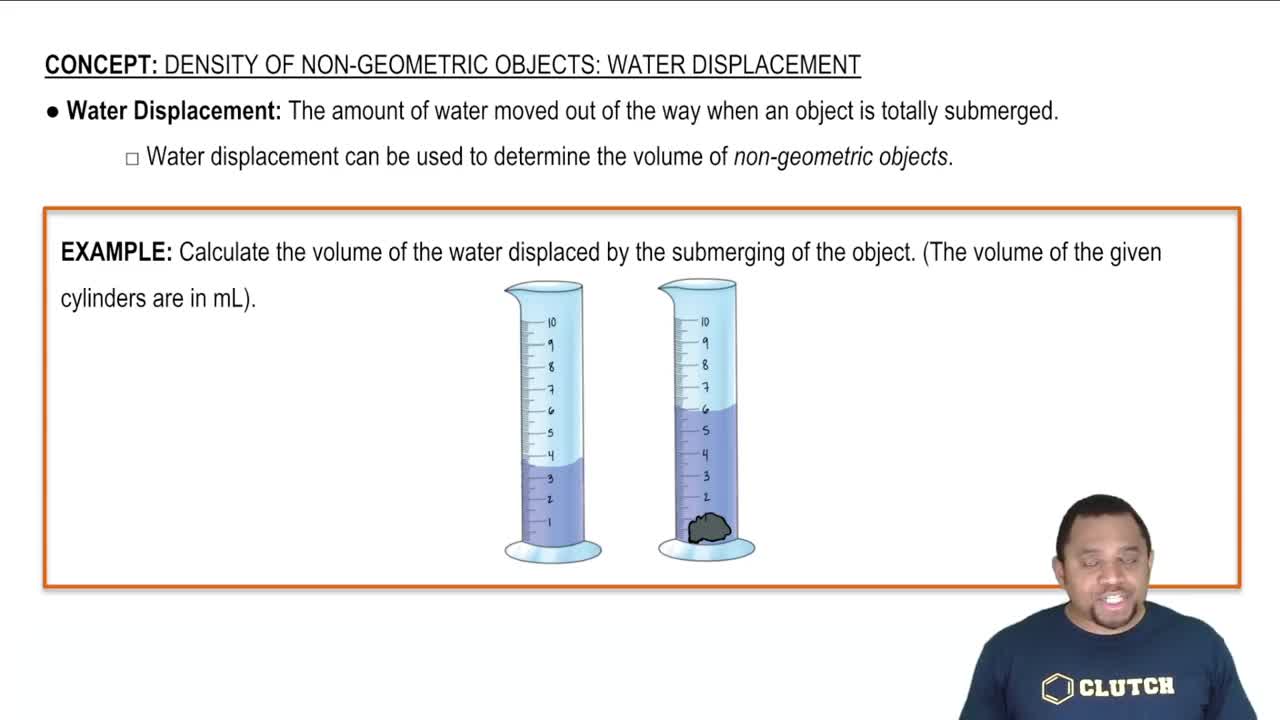
Step 3: Determine the volume of the gem. The volume can be calculated by finding the difference in water levels before and after the gem is placed in the graduated cylinder. Use the formula \( \text{Volume of gem} = \text{Final water level} - \text{Initial water level} \). Substitute the values: \( \text{Volume of gem} = 13.45 \text{ mL} - 12.00 \text{ mL} \).
Step 4: Substitute the mass and calculated volume into the density formula. \( \text{Density} = \frac{4.50 \text{ g}}{\text{Volume of gem}} \).
Step 5: Perform the division to calculate the density. Ensure the units are consistent (g/mL) and interpret the result as the density of the gem.

Verified video answer for a similar problem:

This video solution was recommended by our tutors as helpful for the problem above.
Video duration:
1m
Was this helpful?

Key Concepts

Here are the essential concepts you must grasp in order to answer the question correctly.

Density

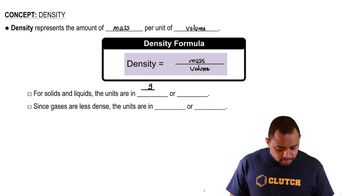
Density is defined as the mass of an object divided by its volume, typically expressed in grams per milliliter (g/mL) for liquids and solids. It is a crucial property that helps identify substances and understand their behavior in different environments. In this context, density can be calculated using the formula: Density = Mass/Volume.
Recommended video:

Volume Displacement

Volume displacement is a method used to measure the volume of an irregularly shaped object by observing the change in liquid level when the object is submerged. In this scenario, the initial water level is 12.00 mL, and it rises to 13.45 mL when the gem is added, indicating that the volume of the gem is the difference, which is 1.45 mL.
Recommended video:
Guided course
01:36
Density of Non-Geometric Objects Concept and Example

Measurement Units

Measurement units are standardized quantities used to express physical properties. In this problem, mass is measured in grams (g) and volume in milliliters (mL). Understanding these units is essential for accurately calculating density and interpreting the results, as they ensure consistency and clarity in scientific communication.
Recommended video:
Guided course
02:52
Measuring Radioactivity Concept 1