Pearson+ LogoPearson+ Logo
Ch.5 Nuclear Chemistry
Timberlake - Chemistry: An Introduction to General, Organic, and Biological Chemistry 13th Edition
Timberlake13th EditionChemistry: An Introduction to General, Organic, and Biological ChemistryISBN: 9780134421353Not the one you use?Change textbook
Chapter 5, Problem 70a

What are the products in the fission of uranium-235 that make possible a nuclear chain reaction?

Verified step by step guidance
1
Understand the concept of nuclear fission: Nuclear fission is a process in which a heavy nucleus, such as uranium-235, splits into smaller nuclei when it absorbs a neutron. This process releases a large amount of energy and additional neutrons, which can trigger further fission reactions in a chain reaction.
Identify the typical fission products: When uranium-235 undergoes fission, it splits into two smaller nuclei (fission fragments) and releases additional neutrons. The specific fission products can vary, but common examples include isotopes like barium-141 (Ba-141) and krypton-92 (Kr-92).
Write the nuclear equation for the fission reaction: The general form of the equation is: U235 + 1 n Ba141 + Kr92 + 3 n This equation shows uranium-235 absorbing a neutron, splitting into barium-141 and krypton-92, and releasing three neutrons.
Explain the role of the released neutrons: The three neutrons released in the fission process can collide with other uranium-235 nuclei, causing additional fission reactions. This is the basis of a nuclear chain reaction, which can be controlled in a nuclear reactor or uncontrolled in a nuclear explosion.
Summarize the products: The products of uranium-235 fission include two smaller nuclei (fission fragments, such as barium-141 and krypton-92), additional neutrons, and a significant amount of energy. These products are essential for sustaining a nuclear chain reaction.

Verified video answer for a similar problem:

This video solution was recommended by our tutors as helpful for the problem above.
Video duration:
1m
Was this helpful?

Key Concepts

Here are the essential concepts you must grasp in order to answer the question correctly.

Nuclear Fission

Nuclear fission is the process by which a heavy atomic nucleus, such as uranium-235, splits into two or more smaller nuclei, along with the release of energy and neutrons. This reaction is initiated when a nucleus absorbs a neutron, becoming unstable and breaking apart. The energy released during fission can be harnessed for power generation, while the emitted neutrons can trigger further fission events, leading to a chain reaction.
Recommended video:
Guided course
02:06
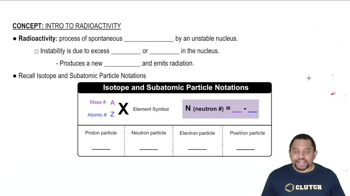
Types of Radiation Concept 1

Chain Reaction

A chain reaction occurs when the products of a nuclear fission event, particularly the released neutrons, induce additional fission events in nearby nuclei. In the case of uranium-235, each fission can release 2-3 neutrons, which can then collide with other uranium-235 nuclei, perpetuating the reaction. For a sustained chain reaction, a critical mass of fissile material is required to ensure that enough neutrons are available to continue the process.
Recommended video:
Guided course
3:10
Intro to Electron Transport Chain Concept 1

Fission Products

Fission products are the smaller nuclei formed when a heavy nucleus like uranium-235 undergoes fission. These products typically include isotopes of elements such as barium, krypton, and strontium, along with additional neutrons. Some of these fission products are radioactive and can contribute to the energy output of the reaction, while others can absorb neutrons and potentially inhibit the chain reaction if not managed properly.
Recommended video:
Guided course
01:37
Solubility Product Constant (Ksp) Concept 2