Pearson+ LogoPearson+ Logo
Ch.6 Ionic and Molecular Compounds
Timberlake - Chemistry: An Introduction to General, Organic, and Biological Chemistry 13th Edition
Timberlake13th EditionChemistry: An Introduction to General, Organic, and Biological ChemistryISBN: 9780134421353Not the one you use?Change textbook
Chapter 6, Problem 65

Which electronegativity difference (a, b, or c) would you expect for a nonpolar covalent bond?
a. from 0.0 to 0.4
b. from 0.5 to 1.8
c. from 1.9 to 3.3

Verified step by step guidance
1
Step 1: Recall the definition of a nonpolar covalent bond. A nonpolar covalent bond occurs when two atoms share electrons equally, which happens when the electronegativity difference between the two atoms is very small or zero.
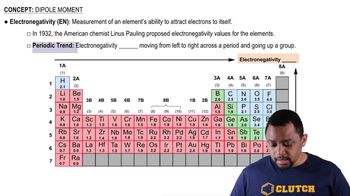
Step 2: Understand the role of electronegativity difference. Electronegativity is a measure of an atom's ability to attract shared electrons in a bond. A small difference in electronegativity (close to 0) indicates equal sharing of electrons, characteristic of a nonpolar covalent bond.
Step 3: Analyze the given ranges of electronegativity differences: (a) 0.0 to 0.4, (b) 0.5 to 1.8, and (c) 1.9 to 3.3. Note that as the difference increases, the bond becomes more polar, and eventually ionic if the difference is very large.
Step 4: Identify the range that corresponds to a nonpolar covalent bond. Since nonpolar covalent bonds have an electronegativity difference close to 0, the range 0.0 to 0.4 (option a) is the most appropriate.
Step 5: Conclude that the electronegativity difference for a nonpolar covalent bond is expected to fall within the range of 0.0 to 0.4, as this indicates minimal or no polarity in the bond.

Verified video answer for a similar problem:

This video solution was recommended by our tutors as helpful for the problem above.
Video duration:
1m
Was this helpful?

Key Concepts

Here are the essential concepts you must grasp in order to answer the question correctly.

Electronegativity

Electronegativity is a measure of an atom's ability to attract and hold onto electrons in a chemical bond. It is a key factor in determining the nature of the bond formed between two atoms. The higher the electronegativity, the stronger the atom's pull on the shared electrons.
Recommended video:
Guided course
01:51
Dipole Moment (Simplified) Concept 1

Covalent Bonds

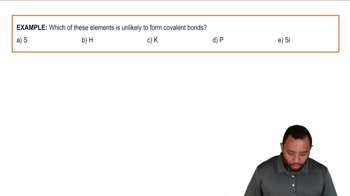
Covalent bonds are formed when two atoms share one or more pairs of electrons. The nature of the bond can vary based on the difference in electronegativity between the two atoms. Nonpolar covalent bonds occur when the electronegativity difference is minimal, leading to an equal sharing of electrons.
Recommended video:
Guided course
01:04
Covalent Bonds Example 1

Electronegativity Difference

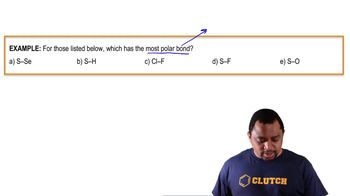
The electronegativity difference between two atoms determines the type of bond they will form. A difference of 0.0 to 0.4 typically indicates a nonpolar covalent bond, where electrons are shared equally. In contrast, larger differences suggest polar covalent or ionic bonds, where electron sharing is unequal.
Recommended video:
Guided course
01:07
Dipole Moment (Simplified) Example 3