Pearson+ LogoPearson+ Logo
Ch.7 Chemical Quantities and Reactions
Timberlake - Chemistry: An Introduction to General, Organic, and Biological Chemistry 13th Edition
Timberlake13th EditionChemistry: An Introduction to General, Organic, and Biological ChemistryISBN: 9780134421353Not the one you use?Change textbook
Chapter 7, Problem 106a

Propane gas, C3H8, undergoes combustion with oxygen gas to produce carbon dioxide and water gases. Propane has a density of 2.02 g/L at room temperature.
a. Write the balanced chemical equation.

Verified step by step guidance
1
Step 1: Write the unbalanced chemical equation for the combustion of propane. Combustion reactions involve a hydrocarbon reacting with oxygen gas (O₂) to produce carbon dioxide (CO₂) and water (H₂O). The unbalanced equation is: C₃H₈ + O₂ → CO₂ + H₂O.
Step 2: Balance the carbon (C) atoms. Propane (C₃H₈) contains 3 carbon atoms, so you need 3 CO₂ molecules on the product side. The equation becomes: C₃H₈ + O₂ → 3CO₂ + H₂O.
Step 3: Balance the hydrogen (H) atoms. Propane contains 8 hydrogen atoms, so you need 4 H₂O molecules on the product side to balance the hydrogen. The equation now looks like: C₃H₈ + O₂ → 3CO₂ + 4H₂O.
Step 4: Balance the oxygen (O) atoms. On the product side, there are 3 CO₂ molecules (3 × 2 = 6 oxygen atoms) and 4 H₂O molecules (4 × 1 = 4 oxygen atoms), for a total of 10 oxygen atoms. On the reactant side, O₂ is diatomic, so you need 5 O₂ molecules to provide 10 oxygen atoms. The balanced equation becomes: C₃H₈ + 5O₂ → 3CO₂ + 4H₂O.
Step 5: Verify the balance. Check that the number of each type of atom is the same on both sides of the equation. There are 3 carbon atoms, 8 hydrogen atoms, and 10 oxygen atoms on both sides, confirming the equation is balanced.

Verified video answer for a similar problem:

This video solution was recommended by our tutors as helpful for the problem above.
Video duration:
3m
Was this helpful?

Key Concepts

Here are the essential concepts you must grasp in order to answer the question correctly.

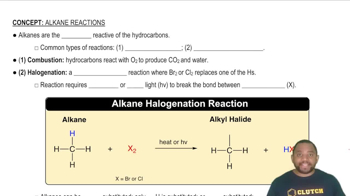
Combustion Reaction

A combustion reaction is a chemical process in which a substance reacts rapidly with oxygen, producing heat and light. In the case of propane (C₃H₈), it combusts in the presence of oxygen (O₂) to yield carbon dioxide (CO₂) and water (H₂O). This type of reaction is essential in understanding energy production in fuels.
Recommended video:
Guided course
2:25
Common Types of Alkane Reactions Concept 1

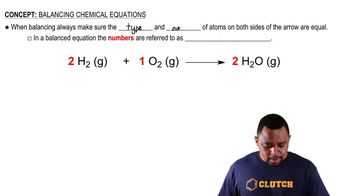
Balancing Chemical Equations

Balancing chemical equations involves ensuring that the number of atoms for each element is the same on both sides of the equation. This is crucial for obeying the law of conservation of mass, which states that matter cannot be created or destroyed in a chemical reaction. Proper balancing allows for accurate stoichiometric calculations.
Recommended video:
Guided course
01:32
Balancing Chemical Equations (Simplified) Concept 1

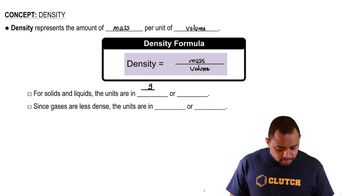
Molar Volume and Density

Density is defined as mass per unit volume and is a key property in determining how substances behave in reactions. For gases, the molar volume at standard temperature and pressure (STP) is approximately 22.4 L/mol. Understanding the density of propane (2.02 g/L) helps in calculating the amount of propane available for combustion and its stoichiometric relationships.
Recommended video: