Pearson+ LogoPearson+ Logo
Ch.9 Solutions
Timberlake - Chemistry: An Introduction to General, Organic, and Biological Chemistry 13th Edition
Timberlake13th EditionChemistry: An Introduction to General, Organic, and Biological ChemistryISBN: 9780134421353Not the one you use?Change textbook
Chapter 9, Problem 57b

Determine the final volume, in milliliters, of each of the following:
b. a 2.0% (m/v) LiCl solution prepared from 50.0 mL of a 10.0% (m/v) LiCl solution

Verified step by step guidance
1
Step 1: Understand the problem. You are tasked with determining the final volume of a 2.0% (m/v) LiCl solution that is prepared by diluting a 10.0% (m/v) LiCl solution. This is a dilution problem, and the relationship between the initial and final concentrations and volumes can be expressed using the dilution equation: CiVi=CfVf, where Ci and Vi are the initial concentration and volume, and Cf and Vf are the final concentration and volume.
Step 2: Write down the known values. From the problem, the initial concentration Ci is 10.0% (m/v), the initial volume Vi is 50.0 mL, and the final concentration Cf is 2.0% (m/v). The final volume Vf is what we need to calculate.
Step 3: Rearrange the dilution equation to solve for the final volume Vf. The equation becomes: Vf=CiViCf.
Step 4: Substitute the known values into the rearranged equation. Replace Ci with 10.0%, Vi with 50.0 mL, and Cf with 2.0%. The equation becomes: Vf=10.0×50.02.0.
Step 5: Perform the calculation to find the final volume Vf. Ensure that the units are consistent and the result is expressed in milliliters (mL).

Verified video answer for a similar problem:

This video solution was recommended by our tutors as helpful for the problem above.
Video duration:
2m
Was this helpful?

Key Concepts

Here are the essential concepts you must grasp in order to answer the question correctly.

Mass/Volume Percent (m/v)

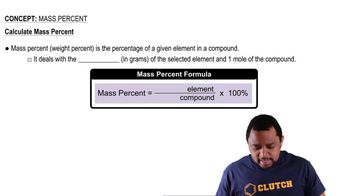
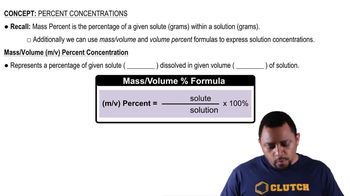
Mass/volume percent (m/v) is a concentration unit that expresses the mass of solute in grams per 100 mL of solution. For example, a 2.0% (m/v) solution of LiCl means there are 2 grams of LiCl in every 100 mL of the solution. Understanding this concept is crucial for calculating the final volume of a solution when diluting or mixing different concentrations.
Recommended video:
Guided course
00:38
Mass Percent Concept

Dilution Principle

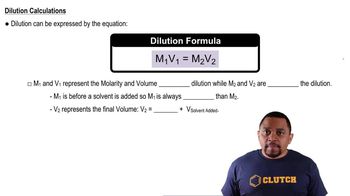
The dilution principle states that when a solution is diluted, the amount of solute remains constant, while the volume of the solution increases. This can be mathematically represented by the equation C1V1 = C2V2, where C is concentration and V is volume. This principle is essential for determining the final volume of a solution after mixing or diluting a more concentrated solution.
Recommended video:

Concentration Calculation

Concentration calculation involves determining the amount of solute in a given volume of solution. In this context, it requires calculating the amount of LiCl in the initial 50.0 mL of a 10.0% solution and then using that amount to find the final volume needed to achieve a 2.0% concentration. This calculation is fundamental for preparing solutions with desired concentrations in laboratory settings.
Recommended video:
Guided course
00:52
Percent Concentrations Concept 1