Pearson+ LogoPearson+ Logo
Ch.9 Solutions
Timberlake - Chemistry: An Introduction to General, Organic, and Biological Chemistry 13th Edition
Timberlake13th EditionChemistry: An Introduction to General, Organic, and Biological ChemistryISBN: 9780134421353Not the one you use?Change textbook
Chapter 9, Problem 53

A patient needs 100. g of glucose in the next 12 h. How many liters of a 5% (m/v) glucose solution must be given?

Verified step by step guidance
1
Step 1: Understand the problem. The patient needs 100 g of glucose, and the solution available is a 5% (m/v) glucose solution. This means there are 5 g of glucose in every 100 mL of the solution. The goal is to determine the volume of the solution required to provide 100 g of glucose.
Step 2: Write the relationship for percent concentration (m/v). The formula is: C = mV × 100, where C is the concentration, m is the mass of solute, and V is the volume of solution in mL.
Step 3: Rearrange the formula to solve for volume. The formula becomes: V = mC × 100. Substitute the known values: m = 100 g and C = 5%.
Step 4: Perform the calculation to find the volume in mL. After substituting the values, calculate V in mL. Remember to divide the mass by the concentration and multiply by 100.
Step 5: Convert the volume from mL to liters. Since 1 L = 1000 mL, divide the volume in mL by 1000 to express the final answer in liters.

Verified video answer for a similar problem:

This video solution was recommended by our tutors as helpful for the problem above.
Video duration:
1m
Was this helpful?

Key Concepts

Here are the essential concepts you must grasp in order to answer the question correctly.

Concentration (m/v)

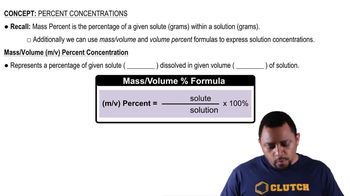
Mass/volume (m/v) concentration expresses the amount of solute in a given volume of solution, typically in grams per 100 mL. A 5% (m/v) glucose solution means there are 5 grams of glucose in every 100 mL of solution. Understanding this concept is crucial for calculating how much solution is needed to deliver a specific mass of glucose.
Recommended video:
Guided course
00:52
Percent Concentrations Concept 1

Dosage Calculation

Dosage calculation involves determining the correct amount of a substance to administer based on patient needs and concentration of the solution. In this case, the patient requires 100 grams of glucose over 12 hours, which necessitates converting the required mass into the volume of the 5% solution. This process ensures that the patient receives the correct therapeutic dose.
Recommended video:
Guided course
03:13
Calculate Oxidation Numbers

Volume Conversion

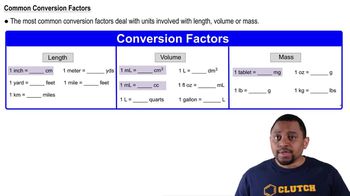
Volume conversion is the process of changing units of measurement for volume, such as converting milliliters to liters. Since the solution concentration is given in grams per 100 mL, and the final answer may need to be in liters, understanding how to convert between these units is essential for accurate dosage administration.
Recommended video:
Guided course
02:10
Conversion Factors (Simplified) Concept 2