Pearson+ LogoPearson+ Logo
Ch.9 Solutions
Timberlake - Chemistry: An Introduction to General, Organic, and Biological Chemistry 13th Edition
Timberlake13th EditionChemistry: An Introduction to General, Organic, and Biological ChemistryISBN: 9780134421353Not the one you use?Change textbook
Chapter 9, Problem 61

You need 500. mL of a 5.0% (m/v) glucose solution. If you have a 25% (m/v) glucose solution on hand, how many milliliters do you need?

Verified step by step guidance
1
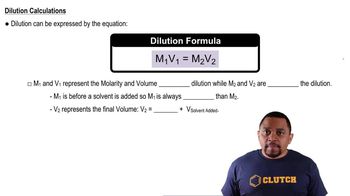
Step 1: Understand the problem. You are tasked with preparing 500. mL of a 5.0% (m/v) glucose solution using a 25% (m/v) glucose solution. This is a dilution problem, where you will use the dilution equation: C1V1 = C2V2, where C1 and V1 are the concentration and volume of the stock solution, and C2 and V2 are the concentration and volume of the diluted solution.
Step 2: Assign the known values to the variables in the dilution equation. The stock solution has a concentration of C1 = 25% (m/v), and you need to find the volume of this stock solution, V1. The diluted solution has a concentration of C2 = 5.0% (m/v) and a volume of V2 = 500. mL.
Step 3: Rearrange the dilution equation to solve for V1, the volume of the stock solution needed. The equation becomes: V1 = (C2V2)/C1.
Step 4: Substitute the known values into the rearranged equation. This gives: V1 = (5.0% × 500. mL) / 25%. Ensure that the units and percentages are consistent throughout the calculation.
Step 5: Perform the calculation to determine the value of V1. This will give you the volume of the 25% (m/v) glucose solution required to prepare the desired 5.0% (m/v) glucose solution.

Verified video answer for a similar problem:

This video solution was recommended by our tutors as helpful for the problem above.
Video duration:
2m
Was this helpful?

Key Concepts

Here are the essential concepts you must grasp in order to answer the question correctly.

Mass/Volume Percentage (m/v)

Mass/volume percentage (m/v) is a concentration unit that expresses the mass of solute in grams per 100 mL of solution. For example, a 5.0% (m/v) glucose solution contains 5 grams of glucose in 100 mL of solution. Understanding this concept is crucial for calculating how much of a concentrated solution is needed to achieve a desired concentration.
Recommended video:
Guided course
00:38
Mass Percent Concept

Dilution Principle

The dilution principle states that the concentration of a solution can be altered by adding more solvent or mixing it with another solution. The relationship can be expressed using the formula C1V1 = C2V2, where C1 and V1 are the concentration and volume of the initial solution, and C2 and V2 are the concentration and volume of the final solution. This principle is essential for determining how to prepare solutions of specific concentrations.
Recommended video:

Volume Calculation

Volume calculation involves determining the amount of liquid required to achieve a specific concentration. In this context, it requires calculating how many milliliters of a higher concentration solution (25% m/v) are needed to create a lower concentration solution (5% m/v) in a total volume of 500 mL. Mastery of volume calculations is vital for accurate solution preparation in laboratory settings.
Recommended video:
Guided course
03:13
Calculate Oxidation Numbers