What is the difference between a 10.0% (v/v) methanol (CH4O) solution and a 10.0% (m/m) methanol solution?
Ch.9 Solutions
Timberlake13th EditionChemistry: An Introduction to General, Organic, and Biological ChemistryISBN: 9780134421353Not the one you use?Change textbook
Chapter 9, Problem 51b
A patient receives 100. mL of 20.% (m/v) mannitol solution every hour.
b. How many grams of mannitol does the patient receive in 12 h?
Verified step by step guidance1
Step 1: Understand the given information. The solution is 20.% (m/v), which means there are 20 grams of mannitol in 100 mL of solution. The patient receives 100 mL of this solution every hour for 12 hours.
Step 2: Calculate the amount of mannitol in 100 mL of solution. Use the formula for mass/volume percent: \( \text{(m/v)} = \frac{\text{mass of solute (g)}}{\text{volume of solution (mL)}} \times 100 \). Rearrange to find the mass of solute: \( \text{mass of solute (g)} = \text{(m/v)} \times \frac{\text{volume of solution (mL)}}{100} \).
Step 3: Substitute the given values into the formula. Use \( \text{(m/v)} = 20 \% \) and \( \text{volume of solution} = 100 \ \text{mL} \) to calculate the mass of mannitol in 100 mL of solution.
Step 4: Determine the total amount of solution the patient receives in 12 hours. Multiply the volume of solution received per hour (100 mL) by the total time (12 hours).
Step 5: Calculate the total mass of mannitol received in 12 hours. Multiply the mass of mannitol in 100 mL (calculated in Step 3) by the total number of 100 mL portions received (calculated in Step 4).

Verified video answer for a similar problem:
This video solution was recommended by our tutors as helpful for the problem above.
Video duration:
4mWas this helpful?
Key Concepts
Here are the essential concepts you must grasp in order to answer the question correctly.
Mannitol Solution Concentration
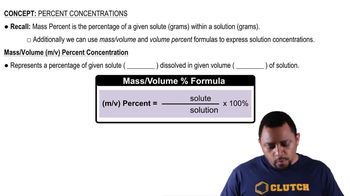
Mannitol solution concentration is often expressed as mass/volume percentage (m/v), which indicates the number of grams of solute (mannitol) per 100 mL of solution. In this case, a 20% (m/v) solution means there are 20 grams of mannitol in every 100 mL of the solution.
Recommended video:
Guided course
Percent Concentrations Concept 1
Volume Administration Rate
The volume administration rate refers to the amount of solution given to a patient over a specific time period. In this scenario, the patient receives 100 mL of mannitol solution every hour, which is crucial for calculating the total volume administered over a longer duration, such as 12 hours.
Recommended video:
Guided course
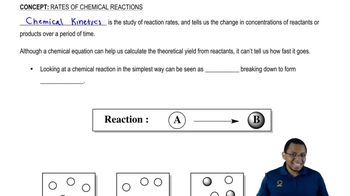
Rate of Reaction Concept 1
Total Dose Calculation
Total dose calculation involves determining the total amount of a substance administered over a specified time. To find out how many grams of mannitol the patient receives in 12 hours, one must multiply the hourly dose of mannitol by the total number of hours, taking into account the concentration of the solution.
Recommended video:
Guided course
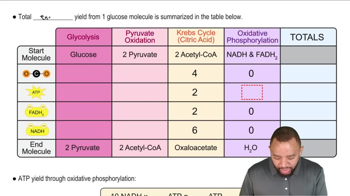
Total Energy From Glucose Concept 2
Related Practice
Textbook Question
1710
views
Textbook Question
Calculate the mass/volume percent (m/v) for the solute in each of the following:
a. 75 g of Na2SO4 in 250 mL of Na2SO4 solution
1348
views
Textbook Question
Calculate the grams or milliliters of solute needed to prepare the following:
c. 250. mL of a 10.0% (v/v) acetic acid solution
910
views
Textbook Question
A patient needs 100. g of glucose in the next 12 h. How many liters of a 5% (m/v) glucose solution must be given?
1207
views
Textbook Question
Determine the final volume, in milliliters, of each of the following:
b. a 2.0% (m/v) LiCl solution prepared from 50.0 mL of a 10.0% (m/v) LiCl solution
2297
views
Textbook Question
You need 500. mL of a 5.0% (m/v) glucose solution. If you have a 25% (m/v) glucose solution on hand, how many milliliters do you need?
2203
views