Pearson+ LogoPearson+ Logo
Ch.9 Solutions
Timberlake - Chemistry: An Introduction to General, Organic, and Biological Chemistry 13th Edition
Timberlake13th EditionChemistry: An Introduction to General, Organic, and Biological ChemistryISBN: 9780134421353Not the one you use?Change textbook
Chapter 9, Problem 79c

Select the diagram that represents the solution formed by a solute <IMAGE> that is a
c. strong electrolyte
<IMAGE>

Verified step by step guidance
1
Step 1: Understand the concept of a strong electrolyte. A strong electrolyte is a substance that completely dissociates into ions when dissolved in water. This means that the solution will contain only ions and no intact molecules of the solute.
Step 2: Analyze the diagram provided. Look for representations of ions in the solution. In a diagram representing a strong electrolyte, you should see individual ions dispersed throughout the solution, rather than clusters or intact molecules.
Step 3: Compare the diagram to the expected behavior of a strong electrolyte. If the diagram shows two distinct particles (such as a cation and an anion) separated and not bonded, it likely represents the dissociation of a strong electrolyte.
Step 4: Confirm that the diagram matches the characteristics of a strong electrolyte solution. Ensure that the particles are ions and not neutral molecules, as neutral molecules would indicate a non-electrolyte or weak electrolyte.
Step 5: Select the diagram that best represents the solution formed by a strong electrolyte, ensuring it aligns with the complete dissociation into ions as described in the concept.

Verified video answer for a similar problem:

This video solution was recommended by our tutors as helpful for the problem above.
Video duration:
4m
Was this helpful?

Key Concepts

Here are the essential concepts you must grasp in order to answer the question correctly.

Strong Electrolytes

Strong electrolytes are substances that completely dissociate into ions when dissolved in water. This means that they produce a high concentration of ions in solution, which allows them to conduct electricity efficiently. Common examples include sodium chloride (NaCl) and potassium nitrate (KNO3). Understanding strong electrolytes is crucial for analyzing solutions and their properties.
Recommended video:
Guided course
02:38
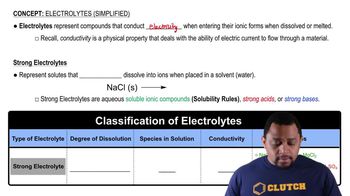
Electrolytes (Simplified) Concept 1

Ionization and Dissociation

Ionization refers to the process by which a neutral molecule gains or loses electrons to form ions, while dissociation is the separation of a compound into its constituent ions in solution. In the context of strong electrolytes, complete dissociation is key, as it leads to a fully ionized solution that can conduct electricity. This concept is fundamental in understanding how solutes behave in aqueous solutions.
Recommended video:
Guided course
02:22
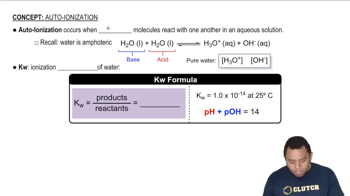
Auto-Ionization and Kw

Conductivity in Solutions

The conductivity of a solution is a measure of its ability to conduct electric current, which is directly related to the concentration of ions present. Strong electrolytes, due to their complete dissociation, result in high conductivity. This property is essential for various applications, including electrochemistry and understanding the behavior of solutions in different chemical processes.
Recommended video: