Pearson+ LogoPearson+ Logo
Ch.9 Solutions
Timberlake - Chemistry: An Introduction to General, Organic, and Biological Chemistry 13th Edition
Timberlake13th EditionChemistry: An Introduction to General, Organic, and Biological ChemistryISBN: 9780134421353Not the one you use?Change textbook
Chapter 9, Problem 38

What is the difference between a 10.0% (v/v) methanol (CH4O) solution and a 10.0% (m/m) methanol solution?

Verified step by step guidance
1
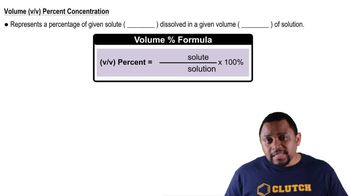
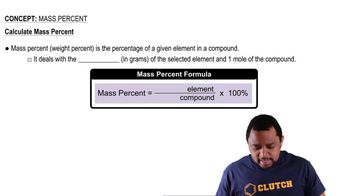
Understand the difference between (v/v) and (m/m) percentages: (v/v) stands for volume/volume percentage, which indicates the volume of solute (methanol) per 100 mL of solution. (m/m) stands for mass/mass percentage, which indicates the mass of solute (methanol) per 100 g of solution.
For a 10.0% (v/v) methanol solution, this means 10.0 mL of methanol is present in every 100 mL of solution. The remaining 90.0 mL would typically be the solvent (e.g., water).
For a 10.0% (m/m) methanol solution, this means 10.0 g of methanol is present in every 100 g of solution. The remaining 90.0 g would typically be the solvent (e.g., water).
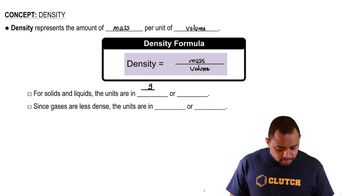
Consider the density of methanol (approximately 0.791 g/mL at room temperature) to understand the relationship between volume and mass. For example, 10.0 mL of methanol would have a mass of approximately 7.91 g, which is less than 10.0 g. This highlights the difference between (v/v) and (m/m) percentages.
Recognize that the key difference lies in how the concentration is expressed: (v/v) focuses on the volume of methanol relative to the solution's total volume, while (m/m) focuses on the mass of methanol relative to the solution's total mass.

Verified video answer for a similar problem:

This video solution was recommended by our tutors as helpful for the problem above.
Video duration:
2m
Was this helpful?

Key Concepts

Here are the essential concepts you must grasp in order to answer the question correctly.

Volume/Volume (v/v) Percentage

Volume/Volume (v/v) percentage is a way to express the concentration of a solution, indicating the volume of solute in a given volume of solution. For example, a 10.0% (v/v) methanol solution means that there are 10 mL of methanol in every 100 mL of the solution. This measurement is particularly useful for liquids, as it directly relates to the volumes involved.
Recommended video:
Guided course
00:26
Percent Concentrations Concept 2

Mass/Mass (m/m) Percentage

Mass/Mass (m/m) percentage expresses the concentration of a solution based on the mass of the solute relative to the total mass of the solution. A 10.0% (m/m) methanol solution indicates that there are 10 grams of methanol in every 100 grams of the solution. This measurement is often used when dealing with solid solutes or when precise mass measurements are required.
Recommended video:
Guided course
00:38
Mass Percent Concept

Density and its Role in Solutions

Density is the mass per unit volume of a substance and plays a crucial role in understanding solutions. The density of methanol and the solution can affect how the volume and mass percentages relate to each other. Since the density of methanol is different from that of water, the same percentage by volume and mass can result in different actual amounts of solute, highlighting the importance of knowing the density when comparing v/v and m/m concentrations.
Recommended video: