Ch. 18 - Practical Applications of Immunology
Tortora - Microbiology: An Introduction 14th Edition
Tortora14th EditionMicrobiology: An IntroductionISBN: 9780138200398Not the one you use?Change textbook
Chapter 18, Problem 4

How are monoclonal antibodies produced?

Verified step by step guidance
1
Understand that monoclonal antibodies are identical antibodies produced by a single clone of B cells, which means they are specific to one epitope of an antigen.
Begin by immunizing a suitable animal, commonly a mouse, with the antigen of interest to stimulate the production of B cells that generate antibodies against that antigen.
Harvest the spleen cells from the immunized animal, as these contain the antibody-producing B cells.
Fuse these spleen B cells with immortal myeloma (cancer) cells to create hybridoma cells; this fusion combines the antibody-producing ability of B cells with the longevity and growth properties of myeloma cells.
Select and culture the hybridoma cells in a selective medium (such as HAT medium) that allows only fused hybrid cells to survive, then screen these hybridomas to identify and isolate those producing the desired monoclonal antibody.

Verified video answer for a similar problem:

This video solution was recommended by our tutors as helpful for the problem above.
Video duration:
2m
Was this helpful?

Key Concepts

Here are the essential concepts you must grasp in order to answer the question correctly.

Hybridoma Technology

Hybridoma technology is the process used to produce monoclonal antibodies by fusing a specific antibody-producing B cell with a myeloma (cancer) cell. This fusion creates a hybrid cell line that can both produce a single type of antibody and proliferate indefinitely in culture.
Recommended video:
Guided course
02:30
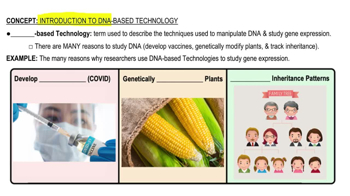
Introduction to DNA-Based Technology

Monoclonal Antibodies

Monoclonal antibodies are identical antibodies produced by a single clone of B cells, targeting one specific epitope on an antigen. They are highly specific and uniform, making them valuable for diagnostics, therapeutics, and research.
Recommended video:
Guided course
02:34
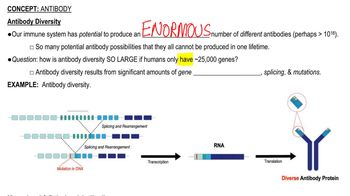
Antibody Diversity

Selection and Screening of Hybridomas

After fusion, hybridoma cells are cultured in selective media to eliminate unfused cells. The surviving hybridomas are screened to identify those producing the desired antibody, which are then cloned to ensure monoclonality and expanded for antibody production.
Recommended video:
Guided course
03:27
Selective Media