Ch. 1 - The Microbial World and You
Tortora - Microbiology: An Introduction 14th Edition
Tortora14th EditionMicrobiology: An IntroductionISBN: 9780138200398Not the one you use?Change textbook
Chapter 1, Problem 8

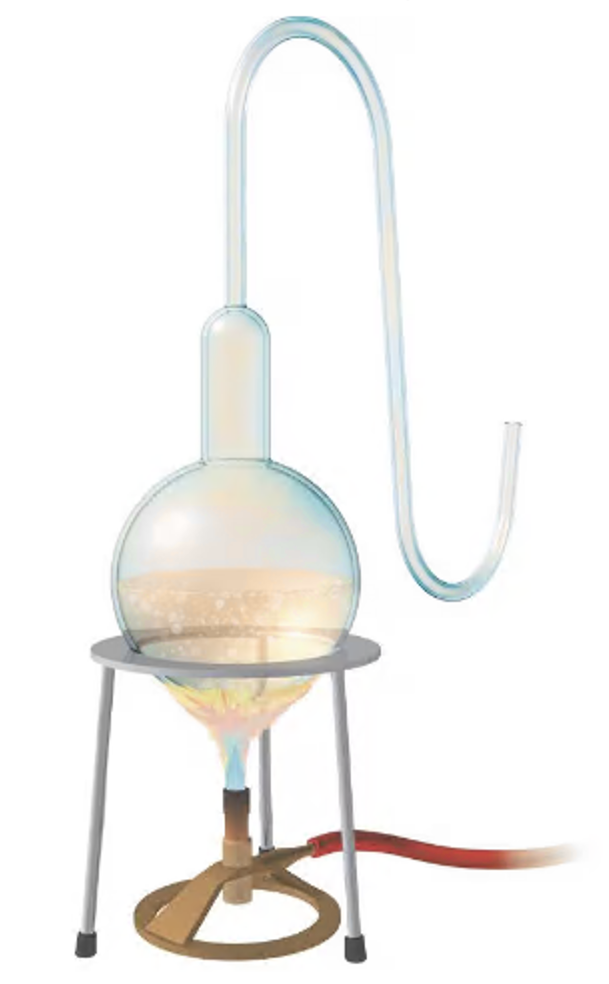
Show where airborne microbes ended up in Pasteur’s experiment.
Glass flask with a curved neck heated over a flame, showing where airborne microbes settle in the neck.

Verified step by step guidance
1
Step 1: Understand the setup of Pasteur's experiment, which involved a swan-neck flask containing nutrient broth. The flask was boiled to kill any existing microbes, and the unique shape of the neck prevented airborne microbes from reaching the broth directly.
Step 2: Identify the path of airborne microbes in the environment. These microbes are present in dust and air particles that can enter the open end of the swan-neck flask but get trapped in the bends of the neck due to gravity and condensation.
Step 3: On your drawing, mark the airborne microbes as small dots or particles entering the open end of the swan-neck flask's neck but accumulating and settling in the curved part of the neck, not reaching the broth.
Step 4: Indicate that the nutrient broth inside the flask remains sterile because the microbes cannot bypass the curved neck to contaminate it, demonstrating that microbes come from the environment and not spontaneously from the broth.
Step 5: Optionally, show what happens if the neck is broken or tilted so that the broth contacts the trapped microbes, leading to microbial growth, which supports Pasteur's conclusion about contamination sources.

Verified video answer for a similar problem:

This video solution was recommended by our tutors as helpful for the problem above.
Was this helpful?

Key Concepts

Here are the essential concepts you must grasp in order to answer the question correctly.

Pasteur's Swan Neck Flask Experiment

This experiment demonstrated that microorganisms in the air are responsible for contamination. Pasteur used flasks with long, curved necks that allowed air in but trapped airborne microbes in the bends, preventing them from reaching the sterile broth inside.
Recommended video:
Guided course
05:58
Pasteur’s Swan-Neck Experiment

Airborne Microbes and Contamination

Airborne microbes are tiny organisms suspended in the air that can settle on surfaces or liquids, causing contamination. In Pasteur’s experiment, these microbes were trapped in the curved neck of the flask, showing that contamination comes from the environment, not spontaneous generation.
Recommended video:
Guided course
07:45
Number of Microbes

Sterilization and Microbial Growth

Sterilization is the process of eliminating all living microorganisms from a medium. Pasteur sterilized the broth by boiling it, and because the microbes were trapped in the flask’s neck, no microbial growth occurred in the broth, proving that microbes come from external sources.
Recommended video:
Guided course
07:36
Terminology of Microbial Growth Control
Related Practice
Textbook Question

What type of microorganism has a peptidoglycan cell wall, has DNA that is not contained in a nucleus, and has flagella?

1798
views

Textbook Question

Spallanzani’s conclusion about spontaneous generation was challenged because Antoine Lavoisier had just shown that oxygen was the vital component of air. Which of the following statements is true?

a. All life requires air.

b. Only disease-causing organisms require air.

c. Some microbes do not require air.

d. Pasteur kept air out of his biogenesis experiments.

e. Lavoisier was mistaken.

1105
views
Textbook Question

Which of the following statements about E. coli is false?

a. E. coli was the first disease-causing bacterium identified by Koch.

b. E. coli is part of the normal microbiome of humans.

c. E. coli is beneficial in human intestines.

d. E. coli gets nutrients from intestinal contents.

e. None of the above; all the statements are true.

1635
views
Textbook Question

It has been said that bacteria are essential for the existence of life on Earth. Which of the following is the essential function performed by bacteria?

a. Control insect populations

b. Directly provide food for humans

c. Decompose organic material and recycle elements

d. Cause disease

e. Produce human hormones such as insulin

1969
views
Textbook Question

Which of the following is an example of bioremediation?

a. Application of oil-degrading bacteria to an oil spill

b. Application of bacteria to a crop to prevent frost damage

c. Fixation of gaseous nitrogen into usable nitrogen

d. Production by bacteria of a human protein such as interferon

e. All of the above

1724
views