
Ch. 16 - Innate Immunity: Nonspecific Defenses of the Host
Tortora - Microbiology: An Introduction 14th Edition
Tortora14th EditionMicrobiology: An IntroductionISBN: 9780138200398Not the one you use?Change textbook
Chapter 16, Problem 6

A decrease in the production of C3 would result in
a. increased susceptibility to infection.
b. increased numbers of white blood cells.
c. increased phagocytosis.
d. activation of C5 through C9.
e. none of the above

Verified step by step guidance
1
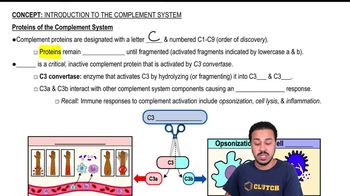
Understand the role of C3 in the complement system, which is a part of the innate immune response. C3 is central to the activation of the complement cascade, leading to opsonization, inflammation, and formation of the membrane attack complex.
Recall that C3 cleavage produces C3a and C3b. C3b acts as an opsonin, enhancing phagocytosis by marking pathogens for destruction, while C3a contributes to inflammation.
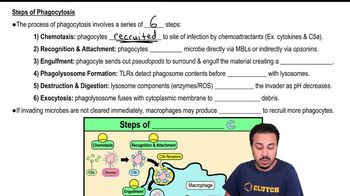
Consider what happens if there is a decrease in C3 production: fewer C3b molecules will be available to opsonize pathogens, leading to reduced phagocytosis.
Recognize that reduced C3 also means less activation of downstream components like C5 through C9, which form the membrane attack complex responsible for lysing pathogens.
Conclude that a decrease in C3 would impair the immune response, making the host more susceptible to infections, which corresponds to option (a) increased susceptibility to infection.

Verified video answer for a similar problem:

This video solution was recommended by our tutors as helpful for the problem above.
Video duration:
2m
Was this helpful?

Key Concepts

Here are the essential concepts you must grasp in order to answer the question correctly.

Complement System and C3 Protein

The complement system is a part of the innate immune response that enhances the ability to clear pathogens. C3 is a central protein in this system, playing a key role in opsonization, inflammation, and activation of downstream components. A decrease in C3 impairs these functions, reducing immune efficiency.
Recommended video:
Guided course
04:16
Proteins of the Complement System

Role of C3 in Phagocytosis

C3b, a fragment of C3, binds to pathogens and marks them for destruction by phagocytes, a process called opsonization. Reduced C3 levels lead to less opsonization, thereby decreasing phagocytosis and weakening pathogen clearance.
Recommended video:
Guided course
08:57
Steps of Phagocytosis

Activation Cascade of Complement Components C5-C9

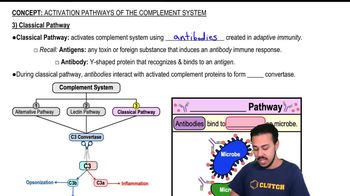
Activation of C3 is necessary to trigger the later stages of the complement cascade, including the formation of the membrane attack complex (C5-C9) that lyses pathogens. Without sufficient C3, this cascade is not effectively initiated, impairing pathogen destruction.
Recommended video:
Guided course
03:42
3) Classical Pathway