Ch. 16 - Innate Immunity: Nonspecific Defenses of the Host
Tortora - Microbiology: An Introduction 14th Edition
Tortora14th EditionMicrobiology: An IntroductionISBN: 9780138200398Not the one you use?Change textbook
Chapter 16, Problem 3

What are interferons? Discuss their roles in innate immunity.

Verified step by step guidance
1
Define interferons as a group of signaling proteins produced and released by host cells in response to the presence of pathogens such as viruses, bacteria, parasites, or tumor cells.
Explain that interferons belong to the cytokine family and play a crucial role in the immune response by interfering with viral replication within host cells.
Describe the main types of interferons: Type I (e.g., IFN-α and IFN-β), Type II (IFN-γ), and Type III (IFN-λ), highlighting that Type I and III are primarily involved in antiviral defense as part of innate immunity.
Discuss how interferons activate immune cells such as natural killer (NK) cells and macrophages, enhance antigen presentation by increasing major histocompatibility complex (MHC) expression, and induce the expression of antiviral proteins in neighboring cells to establish an antiviral state.
Summarize their role in innate immunity as early responders that limit pathogen spread before the adaptive immune system is fully activated, thus providing a rapid and broad-spectrum defense mechanism.

Verified video answer for a similar problem:

This video solution was recommended by our tutors as helpful for the problem above.
Video duration:
1m
Was this helpful?

Key Concepts

Here are the essential concepts you must grasp in order to answer the question correctly.

Interferons

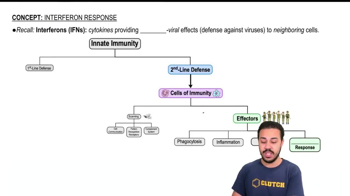
Interferons are signaling proteins produced by host cells in response to viral infections. They belong to a group of cytokines that help regulate the immune response by interfering with viral replication and activating immune cells.
Recommended video:
Guided course
01:32
Interferon Response

Innate Immunity

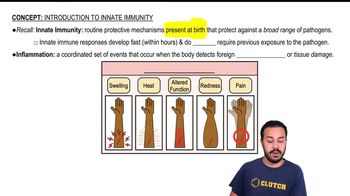
Innate immunity is the body's first line of defense against pathogens, providing a rapid, non-specific response. It includes physical barriers, immune cells, and molecules like interferons that detect and respond to infections immediately.
Recommended video:
Guided course
02:30
Introduction to Innate Immunity

Role of Interferons in Innate Immunity

Interferons enhance innate immunity by inducing antiviral states in neighboring cells, activating natural killer cells, and increasing antigen presentation. This limits viral spread and helps coordinate the early immune response before adaptive immunity develops.
Recommended video:
Guided course
02:30
Introduction to Innate Immunity