Ch. 9 - Biotechnology & DNA Technology
Tortora - Microbiology: An Introduction 14th Edition
Tortora14th EditionMicrobiology: An IntroductionISBN: 9780138200398Not the one you use?Change textbook
Chapter 9, Problem 9

How does RNAi “silence” a gene?

Verified step by step guidance
1
Understand that RNA interference (RNAi) is a biological process where RNA molecules inhibit gene expression by neutralizing targeted mRNA molecules.
Recognize that RNAi involves small RNA molecules, such as small interfering RNA (siRNA) or microRNA (miRNA), which are complementary to the mRNA of the gene to be silenced.
Learn that these small RNA molecules are incorporated into a protein complex called the RNA-induced silencing complex (RISC).
Know that the RISC uses the small RNA as a guide to bind to the complementary mRNA, leading to either cleavage and degradation of the mRNA or inhibition of its translation.
Conclude that by degrading or blocking the mRNA, RNAi effectively prevents the production of the protein encoded by the gene, thereby 'silencing' the gene.

Verified video answer for a similar problem:

This video solution was recommended by our tutors as helpful for the problem above.
Video duration:
2m
Was this helpful?

Key Concepts

Here are the essential concepts you must grasp in order to answer the question correctly.

RNA Interference (RNAi) Mechanism

RNAi is a biological process where small RNA molecules inhibit gene expression by targeting specific mRNA molecules for degradation or translational repression, effectively reducing or silencing the production of the corresponding protein.
Recommended video:
Guided course
04:19
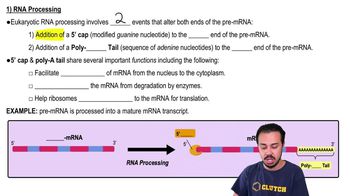
1) RNA Processing

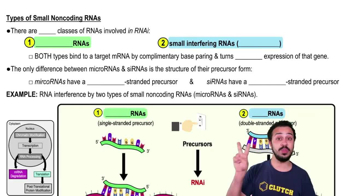
Role of Small Interfering RNA (siRNA) and MicroRNA (miRNA)

siRNAs and miRNAs are short RNA sequences that guide the RNA-induced silencing complex (RISC) to complementary mRNA targets, enabling the complex to cleave or block translation of the mRNA, thus preventing gene expression.
Recommended video:
Guided course
03:58
Eukaryotic Post-Transcriptional Regulation

Gene Silencing via mRNA Degradation or Translational Repression

Once the RISC complex binds to the target mRNA, it either cleaves the mRNA, leading to its degradation, or blocks its translation, both of which prevent the mRNA from producing its protein, resulting in gene silencing.
Recommended video:
Guided course
00:53
Prokaryotic Gene Regulation via Operons