Ch. 21 - Microbial Diseases of the Skin and Eyes
Tortora - Microbiology: An Introduction 14th Edition
Tortora14th EditionMicrobiology: An IntroductionISBN: 9780138200398Not the one you use?Change textbook
Chapter 21, Problem 7

What complications can occur from HSV-1 infections?

Verified step by step guidance
1
Understand that HSV-1 (Herpes Simplex Virus type 1) primarily causes oral herpes, which manifests as cold sores or fever blisters around the mouth.
Recognize that while HSV-1 infections are often mild, complications can arise, especially in immunocompromised individuals or when the virus spreads to other body parts.
Identify common complications such as herpetic keratitis, which is an infection of the eye that can lead to scarring and vision loss if untreated.
Consider the possibility of encephalitis, a serious complication where HSV-1 infects the brain, causing inflammation that can be life-threatening without prompt treatment.
Note other potential complications including herpetic whitlow (infection of the fingers), eczema herpeticum (widespread skin infection), and neonatal herpes if the virus is transmitted to a newborn.

Verified video answer for a similar problem:

This video solution was recommended by our tutors as helpful for the problem above.
Video duration:
2m
Was this helpful?

Key Concepts

Here are the essential concepts you must grasp in order to answer the question correctly.

Herpes Simplex Virus Type 1 (HSV-1) Pathogenesis

HSV-1 is a common virus that primarily causes oral infections, establishing latency in sensory neurons. Understanding its life cycle, including initial infection, latency, and reactivation, is essential to grasp how it can lead to various complications.
Recommended video:
Guided course
10:46
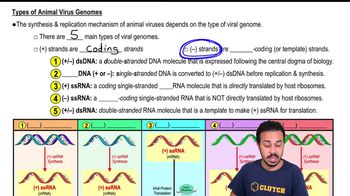
Types of RNA Virus Genomes

Common and Severe Complications of HSV-1

Complications from HSV-1 include cold sores, herpetic keratitis (eye infection), encephalitis (brain inflammation), and neonatal herpes. Recognizing these helps in identifying the clinical significance and potential severity of HSV-1 infections.
Recommended video:
Guided course
03:19
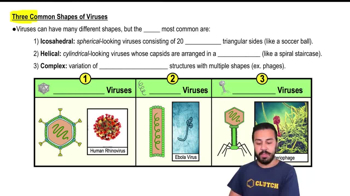
Three Common Shapes of Viruses

Immune Response and Risk Factors

The host immune response controls HSV-1 but can be insufficient in immunocompromised individuals, increasing complication risks. Factors like age, immune status, and site of infection influence the severity and type of complications.
Recommended video:
Guided course
02:57
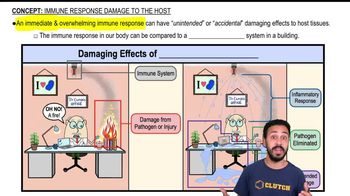
Intro to Immune Response Damage