
Pearson+ LogoPearson+ Logo
Ch. 15 - Innate Immunity
Bauman - Microbiology with Diseases by Taxonomy 6th Edition
Bauman6th EditionMicrobiology with Diseases by TaxonomyISBN: 9780134832302Not the one you use?Change textbook
Chapter 15, Problem 4

The alternative complement activation pathway involves:
a. Factors B, D, and P
b. The cleavage of C5 to form C9
c. Binding to mannose sugar
d. Recognition of antigens bound to specific antibodies

Verified step by step guidance
1
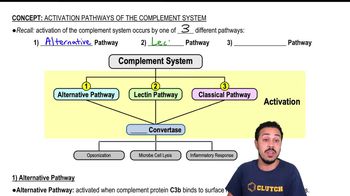
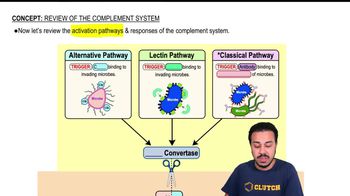
Understand that the complement system has three activation pathways: classical, lectin, and alternative. Each pathway is triggered differently and involves distinct components.
Recall that the alternative pathway is unique because it does not require antibodies for activation, unlike the classical pathway which depends on antigen-antibody complexes.
Identify the key factors involved in the alternative pathway. These include Factors B, D, and P (properdin), which stabilize and promote the formation of the C3 convertase enzyme complex.
Recognize that the cleavage of C5 to form C9 is part of the terminal complement pathway common to all activation routes, not specific to the alternative pathway.
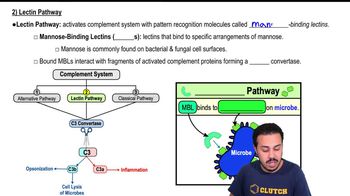
Note that binding to mannose sugars is characteristic of the lectin pathway, which is triggered by mannose-binding lectin recognizing carbohydrate patterns on pathogens.

Verified video answer for a similar problem:

This video solution was recommended by our tutors as helpful for the problem above.
Video duration:
3m
Was this helpful?

Key Concepts

Here are the essential concepts you must grasp in order to answer the question correctly.

Alternative Complement Pathway Components

The alternative complement pathway is initiated by the spontaneous activation of complement component C3 and involves factors B, D, and properdin (factor P). These proteins work together to form a C3 convertase that amplifies the immune response without the need for antibodies.
Recommended video:
Guided course
04:40
1) Alternative Pathway

Complement Cascade and C5 Cleavage

The complement cascade involves sequential activation of proteins leading to the cleavage of C5 into C5a and C5b. C5b initiates the formation of the membrane attack complex (MAC), which includes C6 through C9, ultimately causing lysis of target cells.
Recommended video:
Guided course
05:15
Review of the Complement System

Recognition Mechanisms in Complement Pathways

Different complement pathways recognize pathogens via distinct mechanisms: the lectin pathway binds mannose sugars on microbial surfaces, the classical pathway recognizes antibodies bound to antigens, while the alternative pathway is antibody-independent and triggered by pathogen surfaces.
Recommended video:
Guided course
03:04
2) Lectin Pathway