Pearson+ LogoPearson+ Logo
Ch. 15 - Innate Immunity
Bauman - Microbiology with Diseases by Taxonomy 6th Edition
Bauman6th EditionMicrobiology with Diseases by TaxonomyISBN: 9780134832302Not the one you use?Change textbook
Chapter 15, Problem 3

The complement system involves:
a. The production of antigens and antibodies
b. Serum proteins involved in nonspecific defense
c. A set of genes that distinguish foreign cells from body cells
d. The elimination of undigested remnants of microorganisms

Verified step by step guidance
1
Understand the complement system as part of the immune response, specifically focusing on its role in innate immunity rather than adaptive immunity.
Recall that the complement system consists of a group of serum proteins that work together to enhance the ability of antibodies and phagocytic cells to clear microbes and damaged cells.
Recognize that the complement system is involved in nonspecific defense mechanisms, meaning it acts broadly against pathogens without targeting specific antigens.
Eliminate options that describe processes unrelated to the complement system, such as production of antigens and antibodies (which is adaptive immunity) or genetic recognition of foreign cells (which relates to MHC genes).
Conclude that the complement system primarily involves serum proteins that participate in nonspecific defense, matching option b.

Verified video answer for a similar problem:

This video solution was recommended by our tutors as helpful for the problem above.
Video duration:
5m
Was this helpful?

Key Concepts

Here are the essential concepts you must grasp in order to answer the question correctly.

Complement System

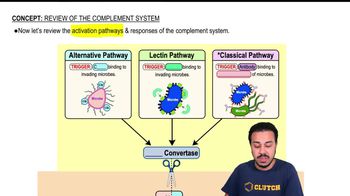
The complement system is a group of serum proteins that play a key role in innate immunity by enhancing the ability of antibodies and phagocytic cells to clear pathogens. It acts nonspecifically to identify and destroy microbes through processes like opsonization, inflammation, and cell lysis.
Recommended video:
Guided course
05:15
Review of the Complement System

Innate vs. Adaptive Immunity

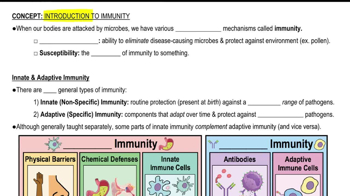
Innate immunity provides immediate, nonspecific defense against pathogens using components like the complement system, while adaptive immunity involves specific responses such as the production of antigens and antibodies tailored to particular invaders.
Recommended video:
Guided course
05:52
Innate vs. Adaptive Immunity

Role of Serum Proteins in Defense

Serum proteins, including complement proteins, circulate in the blood and contribute to nonspecific immune defense by marking pathogens for destruction, recruiting immune cells, and directly lysing microbial membranes, thus forming a crucial part of the body's first line of defense.
Recommended video: