Ch. 2 - The Chemistry of Microbiology
Chapter 2, Problem 2.1a

The outermost electron shell of an atom is known as the _____________ shell.

Verified step by step guidance
1
Identify the basic structure of an atom, which consists of a nucleus containing protons and neutrons, surrounded by electrons in various energy levels or shells.
Understand that electrons are arranged in shells around the nucleus, and these shells are also known as energy levels.
Recognize that the outermost shell of an atom is the one that contains the electrons that are furthest from the nucleus.
Learn that this outermost shell is crucial because it determines the atom's chemical properties and its ability to bond with other atoms.
Fill in the blank with the term that describes this outermost shell, which is commonly referred to as the 'valence' shell.

Verified video answer for a similar problem:

This video solution was recommended by our tutors as helpful for the problem above.
Video duration:
1m
Was this helpful?

Key Concepts

Here are the essential concepts you must grasp in order to answer the question correctly.

Electron Shells

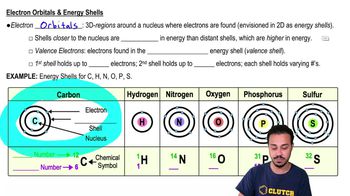
Electron shells are regions around an atom's nucleus where electrons are likely to be found. Each shell corresponds to a specific energy level, with the outermost shell being the highest energy level that can hold electrons. The arrangement of electrons in these shells determines the chemical properties and reactivity of the element.
Recommended video:
Guided course
09:44
Electron Orbitals & Energy Shells

Valence Electrons

Valence electrons are the electrons located in the outermost electron shell of an atom. These electrons play a crucial role in chemical bonding and reactions, as they are involved in forming bonds with other atoms. The number of valence electrons helps determine an element's reactivity and the types of bonds it can form.
Recommended video:
Guided course
03:08
Electron Microscopes

Octet Rule

The octet rule is a chemical principle that states atoms tend to bond in such a way that they have eight electrons in their valence shell, achieving a stable electron configuration similar to that of noble gases. This rule helps explain the formation of ionic and covalent bonds, as atoms will gain, lose, or share electrons to fulfill this requirement.
Recommended video: