Ch. 2 - The Chemistry of Microbiology
Bauman - Microbiology with Diseases by Taxonomy 6th Edition
Bauman6th EditionMicrobiology with Diseases by TaxonomyISBN: 9780134832302Not the one you use?Change textbook
Chapter 2, Problem 4

What is the difference between atomic oxygen and molecular oxygen?

Verified step by step guidance
1
Understand that atomic oxygen refers to a single oxygen atom (O), while molecular oxygen refers to a molecule composed of two oxygen atoms bonded together (O\_2).
Recognize that atomic oxygen is highly reactive and unstable because it has unpaired electrons, making it a free radical.
Note that molecular oxygen (O\_2) is more stable and is the common form of oxygen found in the Earth's atmosphere, essential for respiration in many organisms.
Consider the chemical and physical properties: atomic oxygen is usually found in high-energy environments like the upper atmosphere or during combustion, whereas molecular oxygen is the form involved in biological processes like cellular respiration.
Summarize that the key difference lies in their structure (single atom vs. diatomic molecule) and their stability/reactivity, which influences their roles in chemical and biological systems.

Verified video answer for a similar problem:

This video solution was recommended by our tutors as helpful for the problem above.
Video duration:
3m
Was this helpful?

Key Concepts

Here are the essential concepts you must grasp in order to answer the question correctly.

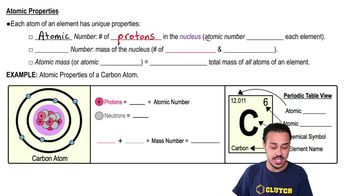
Atomic Oxygen

Atomic oxygen refers to a single oxygen atom (O) that is highly reactive due to its unpaired electrons. It is rarely found freely in nature because it quickly reacts with other atoms or molecules to form more stable compounds.
Recommended video:
Guided course
07:43
Atomic Properties

Molecular Oxygen

Molecular oxygen (O2) consists of two oxygen atoms bonded together, forming a stable diatomic molecule. It is the common form of oxygen found in Earth's atmosphere and is essential for aerobic respiration in living organisms.
Recommended video:
Guided course
03:20
The 3 Molecular Koch's Postulates

Chemical Reactivity and Stability

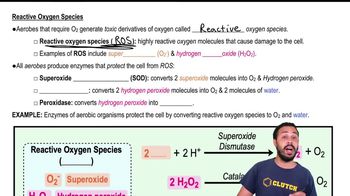
The difference in reactivity between atomic and molecular oxygen arises from their electronic structures; atomic oxygen is highly reactive and short-lived, while molecular oxygen is more stable and less reactive under normal conditions.
Recommended video:
Guided course
04:43
Reactive Oxygen Species