
Ch. 5 - Microbial Metabolism
Chapter 5, Problem SA10

Why do cyanobacteria and algae take in carbon dioxide and give off oxygen?

Verified step by step guidance
1
Understand that cyanobacteria and algae are photosynthetic organisms, meaning they use light energy to convert carbon dioxide and water into organic compounds and oxygen.
Recognize that during photosynthesis, these organisms take in carbon dioxide (CO\_2) from their environment as a carbon source to build carbohydrates.
Know that the process of photosynthesis involves the light-dependent reactions where water molecules (H\_2O) are split, releasing oxygen (O\_2) as a byproduct.
Recall the general photosynthesis equation: \$6CO\_2 + 6H\_2O + light \ energy \rightarrow C\_6H\_{12}O\_6 + 6O\_2$, which shows carbon dioxide intake and oxygen release.
Conclude that cyanobacteria and algae take in carbon dioxide to produce energy-rich organic molecules and release oxygen as a result of splitting water during photosynthesis.

Verified video answer for a similar problem:

This video solution was recommended by our tutors as helpful for the problem above.
Video duration:
2m
Was this helpful?

Key Concepts

Here are the essential concepts you must grasp in order to answer the question correctly.

Photosynthesis

Photosynthesis is the process by which organisms like cyanobacteria and algae convert carbon dioxide and water into glucose and oxygen using sunlight. This process involves light-dependent reactions that produce oxygen as a byproduct and light-independent reactions that fix carbon dioxide into organic molecules.
Recommended video:
Guided course
05:58
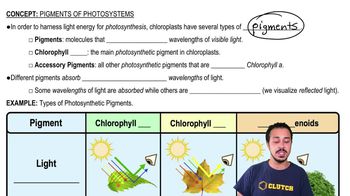
Pigments of Photosynthesis

Role of Chlorophyll and Pigments

Chlorophyll and other pigments in cyanobacteria and algae absorb light energy, which drives the photosynthetic reactions. These pigments capture sunlight, enabling the conversion of CO2 and water into energy-rich compounds, and are essential for oxygen production during photosynthesis.
Recommended video:
Guided course
05:58
Pigments of Photosynthesis

Carbon Dioxide Fixation

Carbon dioxide fixation refers to the incorporation of CO2 into organic molecules during the Calvin cycle. Cyanobacteria and algae use this process to synthesize glucose, which serves as an energy source, while releasing oxygen as a waste product from splitting water molecules.
Recommended video: