Ch. 10 - Host Microbe Interactions and Pathogenesis
Norman-McKay- Microbiology: Basic and Clinical Principles 2nd Edition
Norman-McKay2nd EditionMicrobiology: Basic and Clinical PrinciplesISBN: 9780137661619Not the one you use?Change textbook
Chapter 10, Problem 11

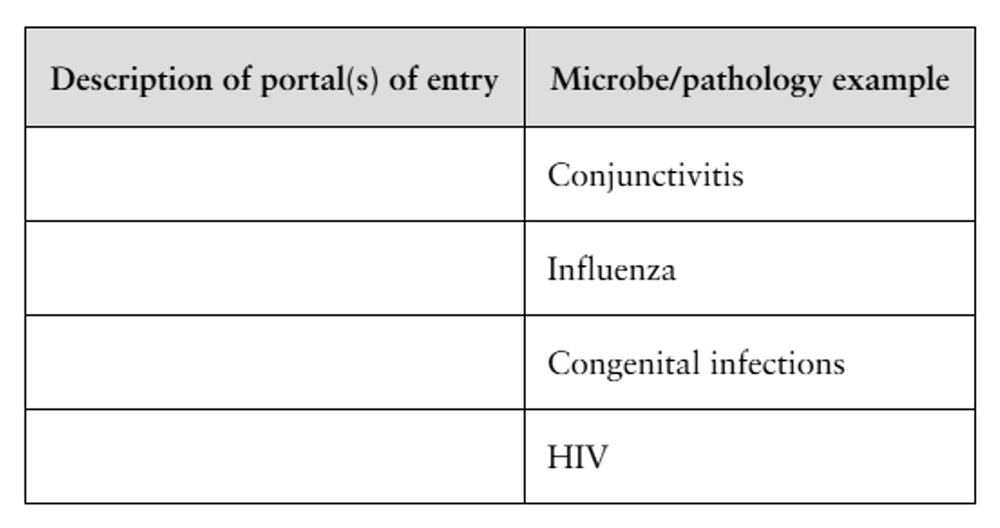
Complete the table:
Table with two columns: portal(s) of entry description and microbe/pathology examples including conjunctivitis, influenza, congenital infections, and HIV.

Verified step by step guidance
1
Since the problem asks to complete a table (likely involving microbiological data), first identify what variables or parameters the table includes (e.g., bacterial species, growth conditions, metabolic products, etc.).
Determine the type of data or values needed to fill in the table cells. This could involve calculating growth rates, enzyme activity, or interpreting experimental results.
If calculations are required, write down the relevant formulas. For example, if calculating bacterial growth, use the formula for exponential growth: \(N_t = N_0 \times 2^{(t/\text{generation time})}\), where \(N_t\) is the number of cells at time \(t\), and \(N_0\) is the initial number of cells.
Use the given data or experimental conditions to substitute values into the formulas. Carefully perform unit conversions if necessary to maintain consistency.
Fill in each cell of the table step-by-step, verifying that each value logically fits with the biological context and the data provided.

Verified video answer for a similar problem:

This video solution was recommended by our tutors as helpful for the problem above.
Video duration:
2m
Was this helpful?

Key Concepts

Here are the essential concepts you must grasp in order to answer the question correctly.

Microbial Classification

Microbial classification involves grouping microorganisms based on shared characteristics such as morphology, genetic makeup, and metabolic properties. Understanding classification helps in identifying microbes and predicting their behavior or pathogenicity.
Recommended video:
Guided course
04:56
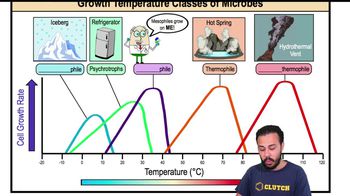
Classification of Microbes by Growth Temperature

Microbial Physiology and Metabolism

This concept covers how microbes obtain energy and nutrients, including processes like respiration, fermentation, and photosynthesis. Knowledge of microbial metabolism is essential for completing tables that compare microbial traits or growth conditions.
Recommended video:
Guided course
02:17
Introduction to Metabolism

Microscopy and Staining Techniques

Microscopy and staining methods, such as Gram staining, are crucial for observing microbial morphology and cell wall properties. These techniques provide visual data often required to complete identification tables in microbiology.
Recommended video:
Guided course
03:46
Light Microscopy: Bright-Field Microscopes