
Ch 33: Wave Optics
Knight Calc - Physics for Scientists and Engineers 5th Edition
Knight Calc5th EditionPhysics for Scientists and EngineersISBN: 9780137344796Not the one you use?Change textbook
Chapter 33, Problem 13

A diffraction grating produces a first-order maximum at an angle of 20.0°. What is the angle of the second-order maximum?

Verified step by step guidance
1
Step 1: Recall the diffraction grating equation: d sin(θ) = mλ, where d is the distance between adjacent slits (grating spacing), θ is the diffraction angle, m is the order of the maximum, and λ is the wavelength of light.
Step 2: For the first-order maximum (m = 1), the angle is given as 20.0°. Use this information to determine the ratio λ/d by rearranging the equation: λ/d = sin(20.0°).
Step 3: For the second-order maximum (m = 2), substitute m = 2 and the previously calculated λ/d into the diffraction grating equation: sin(θ_2) = 2(λ/d).
Step 4: Solve for θ_2 by taking the inverse sine: θ_2 = sin-1(2(λ/d)). Use the value of λ/d from Step 2.
Step 5: Verify that the calculated angle θ_2 is physically valid (i.e., sin(θ_2) must be ≤ 1). If sin(θ_2) exceeds 1, the second-order maximum does not exist.

Verified video answer for a similar problem:

This video solution was recommended by our tutors as helpful for the problem above.
Was this helpful?

Key Concepts

Here are the essential concepts you must grasp in order to answer the question correctly.

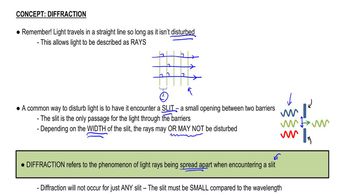
Diffraction Grating

A diffraction grating is an optical component with a periodic structure that disperses light into its constituent wavelengths. It works on the principle of interference, where light waves overlap and combine, producing distinct patterns of maxima and minima. The spacing between the grating lines determines the angles at which these patterns occur.
Recommended video:

Order of Maximum

The order of maximum refers to the specific bright spots produced in a diffraction pattern, labeled by integers (0, 1, 2, etc.). The first-order maximum is the first bright spot on either side of the central maximum (zeroth order). Each order corresponds to a different angle of diffraction, which can be calculated using the grating equation.
Recommended video:
Guided course
06:55
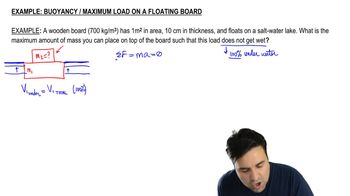
Maximum Load on Floating Board

Grating Equation

The grating equation relates the angle of diffraction to the wavelength of light and the spacing of the grating lines. It is expressed as d sin(θ) = nλ, where d is the distance between grating lines, θ is the angle of the maximum, n is the order of the maximum, and λ is the wavelength. This equation allows for the calculation of angles for different orders of maxima.
Recommended video:
Guided course
08:25
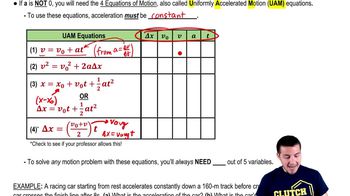
Kinematics Equations
Related Practice
Textbook Question

Light of wavelength 550 nm illuminates a double slit, and the interference pattern is observed on a screen behind the slit. The third maximum is measured to be 3.0 cm from the central maximum. The slits are then illuminated with light of wavelength 440 nm. How far is the fourth maximum from the central maximum?

2059
views
Textbook Question

The two most prominent wavelengths in the light emitted by a hydrogen discharge lamp are 656 nm (red) and 486 nm (blue). Light from a hydrogen lamp illuminates a diffraction grating with 500 lines/mm, and the light is observed on a screen 1.50 m behind the grating. What is the distance between the first-order red and blue fringes?

114
views
Textbook Question

In a single-slit experiment, the slit width is 200 times the wavelength of the light. What is the width (in mm) of the central maximum on a screen 2.0 m behind the slit?

173
views
Textbook Question

In a double-slit experiment, the slit separation is 200 times the wavelength of the light. What is the angular separation (in degrees) between two adjacent bright fringes?

211
views
Textbook Question

A double-slit interference pattern is created by two narrow slits spaced 0.25 mm apart. The distance between the first and the fifth minimum on a screen 60 cm behind the slits is 5.5 mm. What is the wavelength (in nm) of the light used in this experiment?

1817
views
Textbook Question

FIGURE EX33.17 shows the interference pattern on a screen 1.0 m behind an 800 lines/mm diffraction grating. What is the wavelength (in nm) of the light?

2394
views