Ch 32: AC Circuits
Knight Calc - Physics for Scientists and Engineers 5th Edition
Knight Calc5th EditionPhysics for Scientists and EngineersISBN: 9780137344796Not the one you use?Change textbook
Chapter 32, Problem 24b

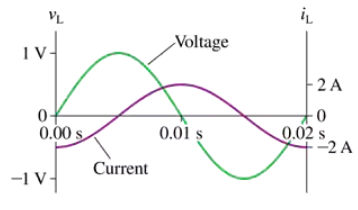
FIGURE EX32.24 shows voltage and current graphs for an inductor. What is the value of the inductance L?

Verified step by step guidance
1
Step 1: Recall the relationship between voltage across an inductor and the rate of change of current. The formula is given by: v=Ldidt, where v is the voltage, L is the inductance, and di/dt is the rate of change of current.
Step 2: Analyze the graph to determine the peak voltage (v) and the corresponding rate of change of current (di/dt). From the graph, the peak voltage is 1 V, and the current changes from 2 A to -2 A over a time interval of 0.01 s.
Step 3: Calculate the rate of change of current (di/dt). Use the formula: ΔiΔt. Here, Δi is the change in current (2 A - (-2 A) = 4 A), and Δt is the time interval (0.01 s).
Step 4: Rearrange the formula for inductance to solve for L: L=vdidt. Substitute the values of v (1 V) and di/dt (calculated in Step 3).
Step 5: Perform the substitution and simplify the expression to find the inductance L. This will give you the value of L in henries (H).

Verified video answer for a similar problem:

This video solution was recommended by our tutors as helpful for the problem above.
Was this helpful?

Key Concepts

Here are the essential concepts you must grasp in order to answer the question correctly.

Inductance

Inductance is a property of an electrical component, typically a coil or inductor, that quantifies its ability to store energy in a magnetic field when an electric current flows through it. It is measured in henries (H) and is defined as the ratio of the induced voltage to the rate of change of current. The greater the inductance, the more energy can be stored for a given current change.
Recommended video:
Guided course
12:59
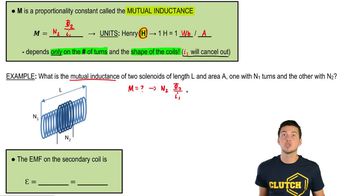
Mutual Induction

Voltage-Current Relationship in Inductors

In inductors, the voltage across the inductor is proportional to the rate of change of current through it. This relationship is described by the formula V = L (di/dt), where V is the voltage, L is the inductance, and di/dt is the rate of change of current. This means that a change in current will induce a voltage that opposes that change, a principle known as Lenz's Law.
Recommended video:
Guided course
07:14
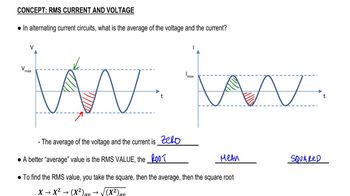
RMS Current and Voltage

Phase Difference

In AC circuits, the voltage and current can be out of phase, meaning they reach their maximum and minimum values at different times. For inductors, the current lags the voltage by 90 degrees (or π/2 radians). This phase difference is crucial for analyzing the behavior of inductors in AC circuits, as it affects the overall impedance and power factor of the circuit.
Recommended video:
Guided course
08:59
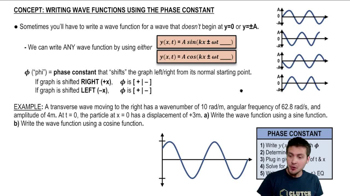
Phase Constant of a Wave Function