Ch 26: Potential and Field
Knight Calc - Physics for Scientists and Engineers 5th Edition
Knight Calc5th EditionPhysics for Scientists and EngineersISBN: 9780137344796Not the one you use?Change textbook
Chapter 26, Problem 74

Derive Equation 26.33 for the induced surface charge density on the dielectric in a capacitor.

Verified step by step guidance
1
Start by understanding the physical setup: A parallel-plate capacitor is partially filled with a dielectric material of permittivity \( \varepsilon \). The goal is to derive the induced surface charge density \( \sigma_{\text{ind}} \) on the dielectric's surface due to polarization.
Recall that the electric displacement field \( \mathbf{D} \) is related to the free surface charge density \( \sigma_f \) on the capacitor plates by \( \mathbf{D} = \varepsilon_0 \mathbf{E} + \mathbf{P} \), where \( \mathbf{P} \) is the polarization vector. For a parallel-plate capacitor, \( \mathbf{D} = \sigma_f \).
The polarization \( \mathbf{P} \) in the dielectric is related to the electric field \( \mathbf{E} \) by \( \mathbf{P} = \chi_e \varepsilon_0 \mathbf{E} \), where \( \chi_e \) is the electric susceptibility of the dielectric. Substituting this into the expression for \( \mathbf{D} \), we get \( \mathbf{D} = \varepsilon_0 \mathbf{E} + \chi_e \varepsilon_0 \mathbf{E} = \varepsilon \mathbf{E} \), where \( \varepsilon = \varepsilon_0 (1 + \chi_e) \).
The induced surface charge density \( \sigma_{\text{ind}} \) is related to the polarization \( \mathbf{P} \) by \( \sigma_{\text{ind}} = \mathbf{P} \cdot \hat{n} \), where \( \hat{n} \) is the unit normal to the surface. Substituting \( \mathbf{P} = \chi_e \varepsilon_0 \mathbf{E} \), we find \( \sigma_{\text{ind}} = \chi_e \varepsilon_0 \mathbf{E} \cdot \hat{n} \).
Finally, express \( \mathbf{E} \) in terms of the free surface charge density \( \sigma_f \) using \( \mathbf{D} = \sigma_f \) and \( \mathbf{D} = \varepsilon \mathbf{E} \). This gives \( \mathbf{E} = \frac{\sigma_f}{\varepsilon} \). Substituting this into the expression for \( \sigma_{\text{ind}} \), we get \( \sigma_{\text{ind}} = \chi_e \varepsilon_0 \frac{\sigma_f}{\varepsilon} \). Simplify further using \( \varepsilon = \varepsilon_0 (1 + \chi_e) \) to obtain the final expression for \( \sigma_{\text{ind}} \).

Verified video answer for a similar problem:

This video solution was recommended by our tutors as helpful for the problem above.
Was this helpful?

Key Concepts

Here are the essential concepts you must grasp in order to answer the question correctly.

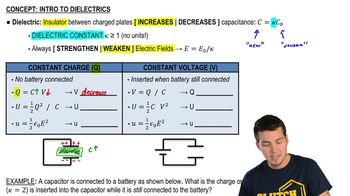
Dielectric Materials

Dielectric materials are insulating substances that can be polarized by an electric field. When placed in a capacitor, they increase the capacitor's ability to store charge by reducing the electric field within the material. This polarization leads to the formation of bound charges on the surface of the dielectric, which is crucial for understanding induced surface charge density.
Recommended video:
Guided course
06:25
Intro To Dielectrics

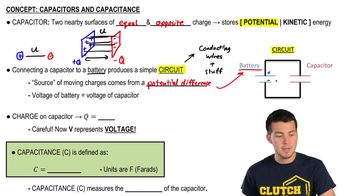
Capacitance

Capacitance is the ability of a system to store electric charge per unit voltage. It is defined as C = Q/V, where C is capacitance, Q is the charge stored, and V is the voltage across the capacitor. The presence of a dielectric increases the capacitance of a capacitor by a factor known as the dielectric constant, which is essential for deriving the induced surface charge density.
Recommended video:
Guided course
08:02
Capacitors & Capacitance (Intro)

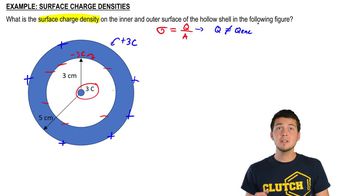
Induced Surface Charge Density

Induced surface charge density refers to the distribution of charge that appears on the surface of a dielectric material when it is subjected to an external electric field. This phenomenon occurs due to the alignment of dipoles within the dielectric, leading to a net charge on the surface. Understanding this concept is key to deriving the equation for the induced surface charge density in a capacitor.
Recommended video:
Guided course
04:03
Surface Charge Density
Related Practice
Textbook Question

An electric dipole at the origin consists of two charges ±q spaced distance s apart along the y-axis. What is the field Ē on the bisecting axis? Does your result agree with Equation 23.11?

125
views

Textbook Question

High-frequency signals are often transmitted along a coaxial cable, such as the one shown in FIGURE P26.68. For example, the cable TV hookup coming into your home is a coaxial cable. The signal is carried on a wire of radius R1 while the outer conductor of radius R2 is grounded (i.e., at V=0 V). An insulating material fills the space between them, and an insulating plastic coating goes around the outside. Evaluate the capacitance per meter of a cable having R1=0.50 mm and R2=3.0 mm.

122
views
Textbook Question

An electric dipole at the origin consists of two charges ±q spaced distance s apart along the y-axis. Assuming s≪x and y, find expressions for Ex and Ey, the components of Ē for a dipole.

39
views
Textbook Question

A vacuum-insulated parallel-plate capacitor with plate separation d has capacitance C0. What is the capacitance if an insulator with dielectric constant κ and thickness d/2 is slipped between the electrodes without changing the plate separation?

93
views
Textbook Question

An electric dipole at the origin consists of two charges ±q spaced distance s apart along the y-axis. Find an expression for the potential V(x, y) at an arbitrary point in the xy-plane. Your answer will be in terms of q, s, x, and y.

1852
views
Textbook Question

The current that charges a capacitor transfers energy that is stored in the capacitor's electric field. Consider a 2.0 μF capacitor, initially uncharged, that is storing energy at a constant 200 W rate. What is the capacitor voltage 2.0 μs after charging begins?

128
views