Ch 01: Concepts of Motion
Knight Calc - Physics for Scientists and Engineers 5th Edition
Knight Calc5th EditionPhysics for Scientists and EngineersISBN: 9780137344796Not the one you use?Change textbook
Chapter 1, Problem 25c

Convert the following to basic SI units or a combination of basic SI units:
62 ft/day

Verified step by step guidance
1
Step 1: Understand the problem. The goal is to convert the given quantity, 62 ft/day, into basic SI units. The basic SI units for length are meters (m), and for time are seconds (s).
Step 2: Convert feet to meters. Use the conversion factor: 1 foot = 0.3048 meters. Multiply 62 ft by 0.3048 to express the length in meters.
Step 3: Convert days to seconds. Use the conversion factor: 1 day = 24 hours, 1 hour = 3600 seconds. Multiply 1 day by 24 and then by 3600 to express the time in seconds.
Step 4: Combine the results. Divide the converted length in meters by the converted time in seconds to express the speed in meters per second (m/s).
Step 5: Write the final expression in terms of basic SI units. The result will be in m/s, which is a combination of the basic SI units for length and time.

Verified video answer for a similar problem:

This video solution was recommended by our tutors as helpful for the problem above.
Video duration:
1m
Was this helpful?

Key Concepts

Here are the essential concepts you must grasp in order to answer the question correctly.

SI Units

The International System of Units (SI) is the standard system of measurement used in science and engineering. It is based on seven base units, including the meter for length, the kilogram for mass, and the second for time. Understanding SI units is essential for converting measurements from other systems, such as the imperial system, to ensure consistency and accuracy in scientific calculations.
Recommended video:
Guided course
03:18
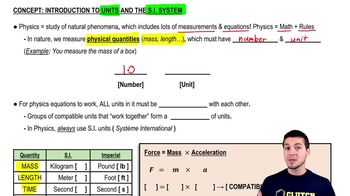
Introduction to Units & the SI System

Unit Conversion

Unit conversion is the process of converting a quantity expressed in one set of units to another set of units. This involves using conversion factors, which are ratios that express how many of one unit are equivalent to another. For example, to convert feet to meters, one must know that 1 foot is approximately 0.3048 meters. Mastery of unit conversion is crucial for solving problems that require different units.
Recommended video:
Guided course
07:46
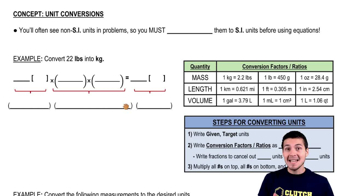
Unit Conversions

Velocity

Velocity is a vector quantity that refers to the rate of change of an object's position with respect to time. It is typically expressed in units of distance per time, such as meters per second (m/s) or feet per day (ft/day). Understanding velocity is important for interpreting motion and for performing conversions between different units of speed, which is necessary in the given question.
Recommended video:
Guided course
7:27
Escape Velocity