A bowling ball rolls up an incline and then onto a smooth, level surface. Draw a complete motion diagram of the bowling ball. Don't try to find the acceleration vector at the point where the motion changes direction; that's an issue for Chapter 4.
Ch 01: Concepts of Motion
Knight Calc5th EditionPhysics for Scientists and EngineersISBN: 9780137344796Not the one you use?Change textbook
Chapter 1, Problem 23c
How many significant figures are there in each of the following values?
75.0
Verified step by step guidance1
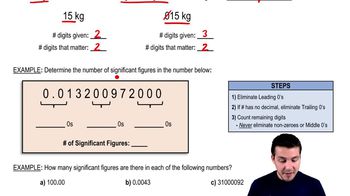
Identify the rules for determining significant figures: Non-zero digits are always significant, zeros between non-zero digits are significant, and trailing zeros are significant only if there is a decimal point.
Analyze the given value, 75.0. Note that it contains two non-zero digits (7 and 5) and one trailing zero after the decimal point.
Apply the rule for trailing zeros: Since the zero is after the decimal point, it is considered significant.
Count all the significant digits in the number: The digits 7, 5, and the trailing zero are all significant.
Conclude that the number 75.0 has three significant figures.

Verified video answer for a similar problem:
This video solution was recommended by our tutors as helpful for the problem above.
Video duration:
1mWas this helpful?
Key Concepts
Here are the essential concepts you must grasp in order to answer the question correctly.
Significant Figures
Significant figures are the digits in a number that contribute to its precision. This includes all non-zero digits, any zeros between significant digits, and trailing zeros in the decimal portion. Understanding significant figures is crucial for accurately reporting measurements and calculations in scientific contexts.
Recommended video:
Guided course
Counting Significant Figures
Rules for Counting Significant Figures
There are specific rules for determining the number of significant figures in a value. For example, all non-zero digits are significant, leading zeros are not significant, and trailing zeros in a decimal number are significant. Knowing these rules helps in identifying how precise a measurement is.
Recommended video:
Guided course
Counting Significant Figures
Rounding and Precision
Rounding is the process of adjusting the digits in a number to reflect a certain level of precision, often determined by the number of significant figures. When performing calculations, it is important to maintain the correct number of significant figures to ensure that the final result accurately represents the precision of the measurements involved.
Recommended video:
Guided course
Counting Significant Figures
Related Practice
Textbook Question
842
views
Textbook Question
Your roommate drops a tennis ball from a third-story balcony. It hits the sidewalk and bounces as high as the second story. Draw a complete motion diagram of the tennis ball from the time it is released until it reaches the maximum height on its bounce. Be sure to determine and show the acceleration at the lowest point.
881
views
Textbook Question
Draw a pictorial representation for the following problem. Do not solve the problem. What acceleration does a rocket need to reach a speed of 200 m/s at a height of 1.0 km?
1033
views
Textbook Question
How many significant figures are there in each of the following values?
0.07 x 10⁸
571
views
Textbook Question
Convert the following to basic SI units or a combination of basic SI units:
62 ft/day
1367
views
Textbook Question
Convert the following to basic SI units or a combination of basic SI units:
2.2 x 10⁴ mi2
748
views