

Ch 40: One-Dimensional Quantum Mechanics
Knight Calc - Physics for Scientists and Engineers 5th Edition
Knight Calc5th EditionPhysics for Scientists and EngineersISBN: 9780137344796Not the one you use?Change textbook
Chapter 40, Problem 34b

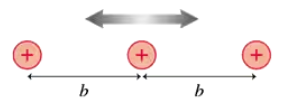
In most metals, the atomic ions form a regular arrangement called a crystal lattice. The conduction electrons in the sea of electrons move through this lattice. FIGURE P40.34 is a one-dimensional model of a crystal lattice. The ions have mass m, charge e, and an equilibrium separation b. Suppose this crystal consists of aluminum ions with an equilibrium spacing of 0.30 nm. What are the energies of the four lowest vibrational states of these ions?

Verified step by step guidance
1
Understand the problem: The question involves finding the energies of the four lowest vibrational states of aluminum ions in a one-dimensional crystal lattice. This is a quantum harmonic oscillator problem, where the ions oscillate about their equilibrium positions.
Step 1: Recall the energy levels of a quantum harmonic oscillator. The energy levels are given by the formula: E=(n+1/2)ω where n is the quantum number (0, 1, 2, ...), is the reduced Planck's constant, and ω is the angular frequency of oscillation.
Step 2: Determine the angular frequency ω. The angular frequency for ions in a crystal lattice can be approximated using the formula: ω=km where k is the effective spring constant and m is the mass of the ion. The spring constant can be related to the interatomic forces in the lattice.
Step 3: Use the equilibrium spacing b (0.30 nm) and the properties of aluminum ions (mass and charge) to estimate the spring constant k. This involves considering the Coulomb force between neighboring ions and their equilibrium separation.
Step 4: Once ω is determined, substitute it into the energy formula for the quantum harmonic oscillator. Calculate the energies for the four lowest vibrational states by setting n = 0, 1, 2, and 3 in the formula. The results will give the energies of the vibrational states in terms of electron volts (eV) or joules.

Verified video answer for a similar problem:

This video solution was recommended by our tutors as helpful for the problem above.
Was this helpful?

Key Concepts

Here are the essential concepts you must grasp in order to answer the question correctly.

Crystal Lattice

A crystal lattice is a three-dimensional arrangement of atoms or ions in a crystalline material. In metals, this structure allows for the orderly placement of positive ions surrounded by a 'sea' of delocalized conduction electrons. The regular spacing between ions, denoted as 'b', is crucial for understanding the interactions and properties of the material, including its vibrational modes.

Vibrational States

Vibrational states refer to the quantized energy levels associated with the oscillations of atoms within a crystal lattice. These states arise from the potential energy stored in the bonds between ions as they vibrate around their equilibrium positions. The lowest vibrational states correspond to the fundamental frequencies of these oscillations, which can be calculated using models of harmonic oscillators.
Recommended video:
Guided course
06:27
Solving Ideal Gas Problems With Changing States

Quantum Harmonic Oscillator

The quantum harmonic oscillator is a model that describes the behavior of particles in a potential well, where the restoring force is proportional to the displacement from equilibrium. In the context of a crystal lattice, each ion can be approximated as a harmonic oscillator, allowing for the calculation of vibrational energy levels using the formula E_n = (n + 1/2)ħω, where n is the quantum number, ħ is the reduced Planck's constant, and ω is the angular frequency of oscillation.
Recommended video:
Guided course
07:52
Simple Harmonic Motion of Pendulums
Related Practice
Textbook Question

A typical electron in a piece of metallic sodium has energy −E₀ compared to a free electron, where E₀ is the 2.36 eV work function of sodium. At what distance beyond the surface of the metal is the electron’s probability density 10% of its value at the surface?

56
views
Textbook Question

In most metals, the atomic ions form a regular arrangement called a crystal lattice. The conduction electrons in the sea of electrons move through this lattice. FIGURE P40.34 is a one-dimensional model of a crystal lattice. The ions have mass m, charge e, and an equilibrium separation b. What wavelength photons are emitted during quantum jumps between adjacent energy levels? Is this wavelength in the infrared, visible, or ultraviolet portion of the spectrum?

1624
views
1
rank
Textbook Question

For a particle in a finite potential well of width L and depth U0, what is the ratio of the probability Prob(in δx at x=L+η) to the probability Prob(in δx at x = L)?

1646
views
Textbook Question

A particle confined in a rigid one-dimensional box of length 10 fm has an energy level En = 32.9 MeV and an adjacent energy level En+1 = 51.4 MeV. What is the mass of the particle? Can you identify it?

88
views
Textbook Question

A particle confined in a rigid one-dimensional box of length 10 fm has an energy level En = 32.9 MeV and an adjacent energy level En+1 = 51.4 MeV. Sketch the n+1 wave function on the n+1 energy level.

74
views
Textbook Question

CALC Consider a particle in a rigid box of length L. For each of the states n = 1,n = 2, and n = 3: Where, in terms of L, are the positions at which the particle is most likely to be found?

52
views