
A typical electron in a piece of metallic sodium has energy −E₀ compared to a free electron, where E₀ is the 2.36 eV work function of sodium. At what distance beyond the surface of the metal is the electron’s probability density 10% of its value at the surface?
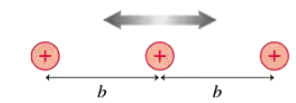
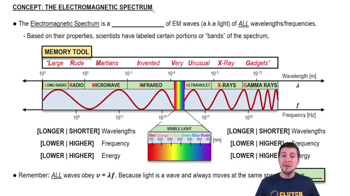
In most metals, the atomic ions form a regular arrangement called a crystal lattice. The conduction electrons in the sea of electrons move through this lattice. FIGURE P40.34 is a one-dimensional model of a crystal lattice. The ions have mass m, charge e, and an equilibrium separation b. What wavelength photons are emitted during quantum jumps between adjacent energy levels? Is this wavelength in the infrared, visible, or ultraviolet portion of the spectrum?

Verified step by step guidance
Verified video answer for a similar problem:
Key Concepts
Crystal Lattice Structure
Quantum Jumps and Energy Levels
Electromagnetic Spectrum
In most metals, the atomic ions form a regular arrangement called a crystal lattice. The conduction electrons in the sea of electrons move through this lattice. FIGURE P40.34 is a one-dimensional model of a crystal lattice. The ions have mass m, charge e, and an equilibrium separation b. Suppose this crystal consists of aluminum ions with an equilibrium spacing of 0.30 nm. What are the energies of the four lowest vibrational states of these ions?
For a particle in a finite potential well of width L and depth U0, what is the ratio of the probability Prob(in δx at x=L+η) to the probability Prob(in δx at x = L)?
A particle confined in a rigid one-dimensional box of length 10 fm has an energy level En = 32.9 MeV and an adjacent energy level En+1 = 51.4 MeV. What is the mass of the particle? Can you identify it?
CALC Consider a particle in a rigid box of length L. For each of the states n = 1,n = 2, and n = 3: Where, in terms of L, are the positions at which the particle is most likely to be found?
CALC Determine the normalization constant A1 for the n = 1 ground-state wave function of the quantum harmonic oscillator. Your answer will be in terms of b.
