Ch 41: Atomic Physics
Knight Calc - Physics for Scientists and Engineers 5th Edition
Knight Calc5th EditionPhysics for Scientists and EngineersISBN: 9780137344796Not the one you use?Change textbook
Chapter 41, Problem 33

Prove that the normalization constant of the 2p radial wave function of the hydrogen atom is (24πaB3)-1/2, as shown in Equations 41.7. Hint: See the hint in Problem 32.

Verified step by step guidance
1
Start by recalling the general form of the radial wave function for the 2p state of the hydrogen atom. It is given by \( R_{2p}(r) = N r e^{-r/(2a_B)} \), where \( N \) is the normalization constant, \( r \) is the radial distance, and \( a_B \) is the Bohr radius.
The normalization condition for the radial wave function states that the total probability of finding the electron in all space must equal 1. Mathematically, this is expressed as \( \int_0^\infty |R_{2p}(r)|^2 r^2 dr = 1 \). Substitute \( R_{2p}(r) = N r e^{-r/(2a_B)} \) into this equation.
Simplify the integrand: \( |R_{2p}(r)|^2 = N^2 r^2 e^{-r/a_B} \). The normalization condition becomes \( N^2 \int_0^\infty r^4 e^{-r/a_B} dr = 1 \).
Evaluate the integral \( \int_0^\infty r^4 e^{-r/a_B} dr \) using the formula for the gamma function or by substitution. The result is \( 24 a_B^5 \). Substitute this back into the normalization condition: \( N^2 (24 a_B^5) = 1 \).
Solve for \( N \): \( N = \sqrt{\frac{1}{24 a_B^5}} \). Since the wave function is normalized over all space, the normalization constant is \( N = \frac{1}{\sqrt{24 \pi a_B^3}} \), as required.

Verified video answer for a similar problem:

This video solution was recommended by our tutors as helpful for the problem above.
Was this helpful?

Key Concepts

Here are the essential concepts you must grasp in order to answer the question correctly.

Radial Wave Function

The radial wave function describes the probability amplitude of finding an electron at a certain distance from the nucleus in a hydrogen atom. It is a function of the radial distance and is crucial for understanding the spatial distribution of electrons in quantum mechanics. For the 2p state, the radial wave function incorporates both the principal quantum number and the angular momentum quantum number, influencing the shape of the electron cloud.
Recommended video:
Guided course
08:30
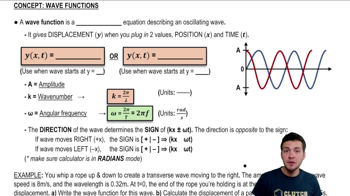
Intro to Wave Functions

Normalization Constant

The normalization constant ensures that the total probability of finding an electron within the entire space is equal to one. In quantum mechanics, wave functions must be normalized to satisfy this condition, which involves integrating the square of the wave function over all space. The specific normalization constant for the 2p radial wave function is derived from this requirement, leading to the expression (24πa_B^3)^(-1/2).
Recommended video:
Guided course
08:59
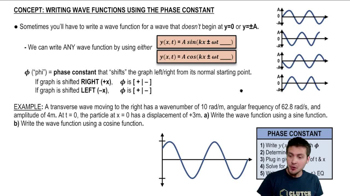
Phase Constant of a Wave Function

Bohr Radius (a_B)

The Bohr radius is a fundamental physical constant that represents the most probable distance between the nucleus and the electron in a hydrogen atom in its ground state. It is approximately 0.529 Å (angstroms) and plays a significant role in quantum mechanics, particularly in the calculation of atomic orbitals. In the context of the normalization constant, the Bohr radius is used to express the scale of the radial wave function, influencing the normalization process.
Recommended video:
Guided course
06:18
Calculating Radius of Nitrogen