Ch 41: Atomic Physics
Knight Calc - Physics for Scientists and Engineers 5th Edition
Knight Calc5th EditionPhysics for Scientists and EngineersISBN: 9780137344796Not the one you use?Change textbook
Chapter 41, Problem 27a

There exist subatomic particles whose spin is characterized by s = 1, rather than the s = ½ of electrons. These particles are said to have a spin of one. What is the magnitude ( as a multiple of ℏ ) of the spin angular momentum S for a particle with a spin of one?

Verified step by step guidance
1
Understand the concept of spin angular momentum: The spin angular momentum of a particle is given by the formula \( S = \sqrt{s(s+1)} \hbar \), where \( s \) is the spin quantum number and \( \hbar \) is the reduced Planck's constant.
Identify the given spin quantum number: In this problem, the spin quantum number \( s \) is provided as \( s = 1 \).
Substitute the value of \( s \) into the formula: Replace \( s \) with 1 in the formula \( S = \sqrt{s(s+1)} \hbar \), resulting in \( S = \sqrt{1(1+1)} \hbar \).
Simplify the expression inside the square root: Calculate \( 1+1 \), which equals 2, so the formula becomes \( S = \sqrt{1 \cdot 2} \hbar \).
Simplify further to find the magnitude: The expression simplifies to \( S = \sqrt{2} \hbar \), which represents the magnitude of the spin angular momentum as a multiple of \( \hbar \).

Verified video answer for a similar problem:

This video solution was recommended by our tutors as helpful for the problem above.
Was this helpful?

Key Concepts

Here are the essential concepts you must grasp in order to answer the question correctly.

Spin Angular Momentum

Spin angular momentum is a fundamental property of particles, akin to classical angular momentum, but it arises from quantum mechanical effects. It is quantized, meaning it can only take on certain discrete values. For a particle with spin quantum number s, the magnitude of its spin angular momentum is given by the formula S = √(s(s + 1))ℏ, where ℏ is the reduced Planck's constant.
Recommended video:
Guided course
12:12
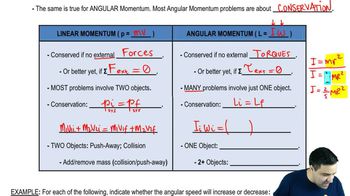
Conservation of Angular Momentum

Quantum Number

Quantum numbers are values that describe the quantized properties of particles in quantum mechanics. The spin quantum number, denoted as s, indicates the intrinsic angular momentum of a particle. For particles with spin s = 1, they can have three possible projections of spin along a chosen axis: +1, 0, and -1, which correspond to the allowed states of the particle.
Recommended video:
Guided course
07:19
Moles & Avogadro's Number

Reduced Planck's Constant (ℏ)

The reduced Planck's constant, denoted as ℏ (h-bar), is a fundamental constant in quantum mechanics, defined as ℏ = h/(2π), where h is the Planck constant. It plays a crucial role in quantifying angular momentum and other quantum properties. In the context of spin, it serves as a scaling factor that relates the quantum mechanical description of spin to classical angular momentum.
Recommended video:
Guided course
08:59
Phase Constant of a Wave Function