
Textbook Question
A friend of yours is loudly singing a single note at 400 Hz while racing toward you at 25.0 m/s on a day when the speed of sound is 340 m/s. What frequency do you hear?
830
views

 Verified step by step guidance
 04:39
04:39
 8:13
8:13 07:32
07:32A friend of yours is loudly singing a single note at 400 Hz while racing toward you at 25.0 m/s on a day when the speed of sound is 340 m/s. What frequency do you hear?
One cue your hearing system uses to localize a sound (i.e., to tell where a sound is coming from) is the slight difference in the arrival times of the sound at your ears. Your ears are spaced approximately 20 cm apart. Consider a sound source 5.0 m from the center of your head along a line 45° to your right. What is the difference in arrival times? Give your answer in microseconds. Hint: You are looking for the difference between two numbers that are nearly the same. What does this near equality imply about the necessary precision during intermediate stages of the calculation?
FIGURE P16.45 is a snapshot graph at t = 0 s of a 5.0 Hz wave traveling to the left. Write the displacement equation for this wave.
A bat locates insects by emitting ultrasonic 'chirps' and then listening for echoes from the bugs. Suppose a bat chirp has a frequency of 25 kHz. How fast would the bat have to fly, and in what direction, for you to just barely be able to hear the chirp at 20 kHz?
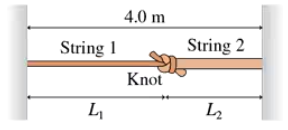
Earthquakes are essentially sound waves—called seismic waves—traveling through the earth. Because the earth is solid, it can support both longitudinal and transverse seismic waves. The speed of longitudinal waves, called P waves, is 8000 m/s. Transverse waves, called S waves, travel at a slower 4500 m/s. A seismograph records the two waves from a distant earthquake. If the S wave arrives 2.0 min after the P wave, how far away was the earthquake? You can assume that the waves travel in straight lines, although actual seismic waves follow more complex routes.
A helium-neon laser beam has a wavelength in air of 633 nm. It takes 1.38 ns for the light to travel through 30 cm of an unknown liquid. What is the wavelength of the laser beam in the liquid?