Ch 36: Special Relativity
Knight Calc - Physics for Scientists and Engineers 5th Edition
Knight Calc5th EditionPhysics for Scientists and EngineersISBN: 9780137344796Not the one you use?Change textbook
Chapter 36, Problem 9

Bjorn is standing at x = 600 m. Firecracker 1 explodes at the origin and firecracker 2 explodes at x = 900 m. The flashes from both explosions reach Bjorn's eye at t = 3.0 μs. At what time did each firecracker explode?

Verified step by step guidance
1
Step 1: Understand the problem setup. Bjorn is located at x = 600 m, and the flashes from two firecrackers (one at x = 0 m and the other at x = 900 m) reach his eyes simultaneously at t = 3.0 μs. We need to determine the time at which each firecracker exploded.
Step 2: Recall that light travels at a constant speed, c = 3.0 × 10⁸ m/s. The time it takes for light to travel a distance d is given by the formula: t=dc. Use this formula to calculate the travel time for the light from each firecracker to reach Bjorn.
Step 3: For firecracker 1 (located at x = 0 m), the distance to Bjorn is 600 m. Calculate the travel time using the formula: t=6003.0×108. This gives the time it took for the flash to reach Bjorn.
Step 4: For firecracker 2 (located at x = 900 m), the distance to Bjorn is 300 m (since Bjorn is at x = 600 m). Calculate the travel time using the formula: t=3003.0×108. This gives the time it took for the flash to reach Bjorn.
Step 5: Subtract the travel times calculated in steps 3 and 4 from the observed time (t = 3.0 μs) to determine the time at which each firecracker exploded. For firecracker 1, subtract its travel time from 3.0 μs. For firecracker 2, subtract its travel time from 3.0 μs. This will give the explosion times for both firecrackers.

Verified video answer for a similar problem:

This video solution was recommended by our tutors as helpful for the problem above.
Video duration:
8m
Was this helpful?

Key Concepts

Here are the essential concepts you must grasp in order to answer the question correctly.

Speed of Light

The speed of light in a vacuum is approximately 299,792 kilometers per second (or about 300,000 kilometers per second). This constant speed is crucial for understanding how quickly light travels from one point to another, which is essential in determining the time it takes for the flashes from the firecrackers to reach Bjorn.
Recommended video:
Guided course
06:03
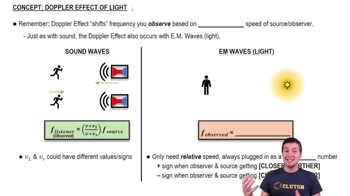
The Doppler Effect (Light)

Time Delay

Time delay refers to the difference in time it takes for light to travel from the source of an event (like an explosion) to an observer. In this scenario, the time delay can be calculated by considering the distances from each firecracker to Bjorn and the speed of light, allowing us to determine when each firecracker exploded based on when the light reached him.
Recommended video:
Guided course
05:59
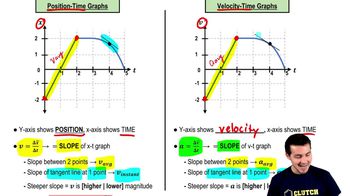
Velocity-Time Graphs & Acceleration

Distance and Time Relationship

The relationship between distance, time, and speed is described by the equation: distance = speed × time. This fundamental concept allows us to calculate the time it takes for light to travel specific distances, which is necessary for solving the problem of when each firecracker exploded based on the distances to Bjorn and the time the flashes reached him.
Recommended video:
Guided course
03:43
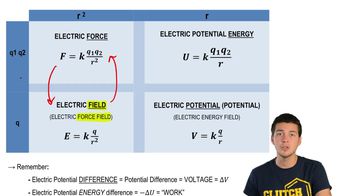
Relationships Between Force, Field, Energy, Potential