An air-track glider attached to a spring oscillates with a period of 1.5 s. At t = 0 s the glider is 5.00 cm left of the equilibrium position and moving to the right at 36.3 cm/s. What is the phase constant?
Ch 15: Oscillations
Knight Calc5th EditionPhysics for Scientists and EngineersISBN: 9780137344796Not the one you use?Change textbook
Chapter 15, Problem 10
An object in simple harmonic motion has an amplitude of 8.0 cm, n angular frequency of 0.25 rad/s, and a phase constant of π rad. Draw a velocity graph showing two cycles of the motion.
Verified step by step guidance1
Step 1: Recall the velocity equation for simple harmonic motion, which is given by v(t) = -ωA sin(ωt + φ), where ω is the angular frequency, A is the amplitude, and φ is the phase constant.
Step 2: Substitute the given values into the velocity equation. Here, ω = 0.25 rad/s, A = 8.0 cm (convert to meters if needed), and φ = π rad. The equation becomes v(t) = -0.25 × 8.0 × sin(0.25t + π).
Step 3: Analyze the phase constant φ = π rad. This means the sine function starts at its minimum value because sin(π) = 0. The velocity graph will be shifted accordingly.
Step 4: Determine the period of the motion using the formula T = 2π/ω. Substituting ω = 0.25 rad/s, we find T = 2π/0.25 = 8π seconds. Two cycles of motion will span 16π seconds.
Step 5: Plot the velocity graph over the time interval [0, 16π] using the equation v(t) = -0.25 × 8.0 × sin(0.25t + π). The graph will be sinusoidal, with peaks and troughs corresponding to the maximum and minimum velocities, and a period of 8π seconds.

Verified video answer for a similar problem:
This video solution was recommended by our tutors as helpful for the problem above.
Video duration:
16mWas this helpful?
Key Concepts
Here are the essential concepts you must grasp in order to answer the question correctly.
Simple Harmonic Motion (SHM)
Simple Harmonic Motion is a type of periodic motion where an object oscillates around an equilibrium position. The motion is characterized by a restoring force proportional to the displacement from the equilibrium, leading to sinusoidal motion. Key parameters include amplitude, frequency, and phase constant, which define the motion's characteristics.
Recommended video:
Guided course
Simple Harmonic Motion of Pendulums
Velocity in SHM
In Simple Harmonic Motion, the velocity of the oscillating object varies sinusoidally with time. It can be expressed as v(t) = -Aω sin(ωt + φ), where A is the amplitude, ω is the angular frequency, and φ is the phase constant. The velocity reaches its maximum at the equilibrium position and is zero at the maximum displacement (amplitude).
Recommended video:
Guided course
Escape Velocity
Graphing SHM
Graphing the velocity of an object in Simple Harmonic Motion involves plotting velocity against time. The resulting graph is a sine wave, reflecting the periodic nature of the motion. The amplitude of the velocity graph corresponds to the maximum speed of the object, while the frequency of the wave relates to the angular frequency of the motion.
Recommended video:
Guided course
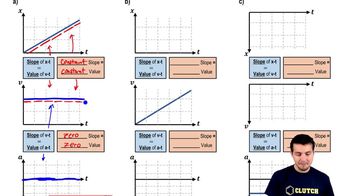
Graphing Position, Velocity, and Acceleration Graphs
Related Practice
Textbook Question
2316
views
1
comments
Textbook Question
FIGURE EX15.7 is the position-versus-time graph of a particle in simple harmonic motion. What is vmax?
2409
views
1
rank
Textbook Question
What are the (a) amplitude, (b) frequency, and (c) phase constant of the oscillation shown in FIGURE EX15.6?
3079
views
2
rank
Textbook Question
A 200 g air-track glider is attached to a spring. The glider is pushed in 10 cm and released. A student with a stopwatch finds that 10 oscillations take 12.0 s. What is the spring constant?
1191
views
Textbook Question
FIGURE EX15.7 is the position-versus-time graph of a particle in simple harmonic motion. What is the phase constant?
2724
views
Textbook Question
A block attached to a spring with unknown spring constant oscillates with a period of 2.0 s. What is the period if the amplitude is doubled?
1206
views