Ch 09: Work and Kinetic Energy
Knight Calc - Physics for Scientists and Engineers 5th Edition
Knight Calc5th EditionPhysics for Scientists and EngineersISBN: 9780137344796Not the one you use?Change textbook
Chapter 9, Problem 28b

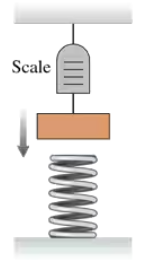
A 5.0 kg mass hanging from a spring scale is slowly lowered onto a vertical spring, as shown in FIGURE EX9.28. The scale reads in newtons. The scale reads 20 N when the lower spring has been compressed by 2.0 cm. What is the value of the spring constant for the lower spring?

Verified step by step guidance
1
Step 1: Identify the forces acting on the system. The spring scale measures the tension in the string, which is the force exerted by the hanging mass. The lower spring exerts an upward force proportional to its compression, according to Hooke's Law.
Step 2: Write the equation for equilibrium. When the lower spring is compressed by 2.0 cm, the forces acting on the mass are balanced. The tension in the string (20 N) plus the upward force from the lower spring equals the gravitational force acting on the mass. Use the equation: \( F_{gravity} = F_{scale} + F_{spring} \).
Step 3: Calculate the gravitational force acting on the mass. Use the formula \( F_{gravity} = m \cdot g \), where \( m = 5.0 \, \text{kg} \) and \( g = 9.8 \, \text{m/s}^2 \).
Step 4: Solve for the force exerted by the lower spring. Rearrange the equilibrium equation to find \( F_{spring} = F_{gravity} - F_{scale} \). Substitute the values for \( F_{gravity} \) and \( F_{scale} \).
Step 5: Use Hooke's Law to find the spring constant. Hooke's Law states \( F_{spring} = k \cdot x \), where \( k \) is the spring constant and \( x \) is the compression distance (2.0 cm or 0.02 m). Rearrange the equation to solve for \( k \): \( k = \frac{F_{spring}}{x} \). Substitute the values for \( F_{spring} \) and \( x \).

Verified video answer for a similar problem:

This video solution was recommended by our tutors as helpful for the problem above.
Was this helpful?

Key Concepts

Here are the essential concepts you must grasp in order to answer the question correctly.

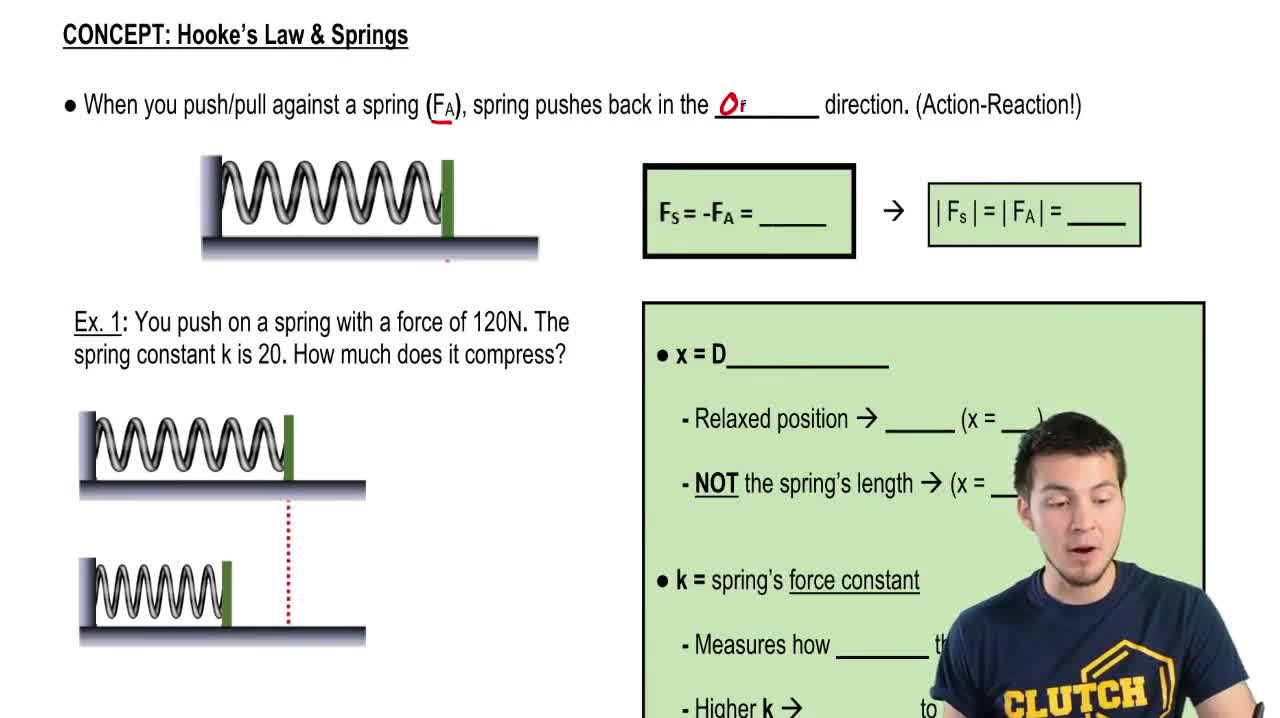
Hooke's Law

Hooke's Law states that the force exerted by a spring is directly proportional to the displacement of the spring from its equilibrium position, expressed mathematically as F = -kx, where F is the force, k is the spring constant, and x is the displacement. This principle is fundamental in understanding how springs behave under load and is essential for calculating the spring constant in this scenario.
Recommended video:
Guided course
05:27
Spring Force (Hooke's Law)

Weight and Force

The weight of an object is the force exerted on it due to gravity, calculated as W = mg, where m is the mass and g is the acceleration due to gravity (approximately 9.81 m/s² on Earth). In this problem, the 5.0 kg mass exerts a downward force of 49.05 N, but the scale reads 20 N when the spring is compressed, indicating that the spring is also exerting an upward force.
Recommended video:
Guided course
10:19
Torque Due to Weight

Spring Constant (k)

The spring constant, denoted as k, is a measure of a spring's stiffness, defined as the ratio of the force exerted on the spring to the displacement caused by that force. A higher k value indicates a stiffer spring. In this question, the spring constant can be determined by rearranging Hooke's Law to k = F/x, where F is the force exerted by the weight and x is the compression of the spring.
Recommended video:
Guided course
08:59
Phase Constant of a Wave Function