The Power of Whimsy, Curiosity, and Side Quests
Many college students know that intrinsic motivation boosts productivity, but how does it work? And why is it so hard to have intrinsic motivation for classes when all we want to do is get the grade and pass?
In this blog, I’ll discuss ways to revive our inner child’s excitement for learning. These methods can help transform that excitement into natural productivity. Behold: the power of whimsy, curiosity, and side quests!
Whimsy vs. Curiosity
What’s the difference between whimsy and curiosity? Many think of curiosity as figuring out the “why” of things. I like to think of whimsy, on the other hand, as figuring out the “why not?” of things.
I’ve found that combining these two qualities makes for a fun day-to-day experience, even when I’m stuck on campus all day.
Taking Side Quests
You’ve probably heard the term “side quests” before. It’s pretty much as it sounds: missions you go on that stray from your “main quest,” or your typical routine.
These side quests help me realize that my days are more than just wake up, school, and sleep. They are what motivate me to keep living life apart from academics.
Harnessing the Power of Whimsy
As I said, whimsy is my “why not.” It’s what gets me up and going for my side quests.
Why shouldn’t I accompany my friend on their grocery shopping day? Why shouldn’t I go to the park and watch the sunset? Why shouldn’t I apply for this public speaking competition?
Many times, you’ll find yourself asking why you should do certain things. Sometimes, it might also be helpful to ask yourself: why not?
Engaging Your Curiosity
At the heart of research and innovation is curiosity. Anything you’ve ever wondered has likely been pondered by someone else. They might have even spent their entire lives researching it.
Curiosity also exists on a smaller scale. It can be as simple as wondering how our bodies react to certain bacteria or how to apply classical conditioning in real life. The more you wonder, the more you learn.
How It All Connects
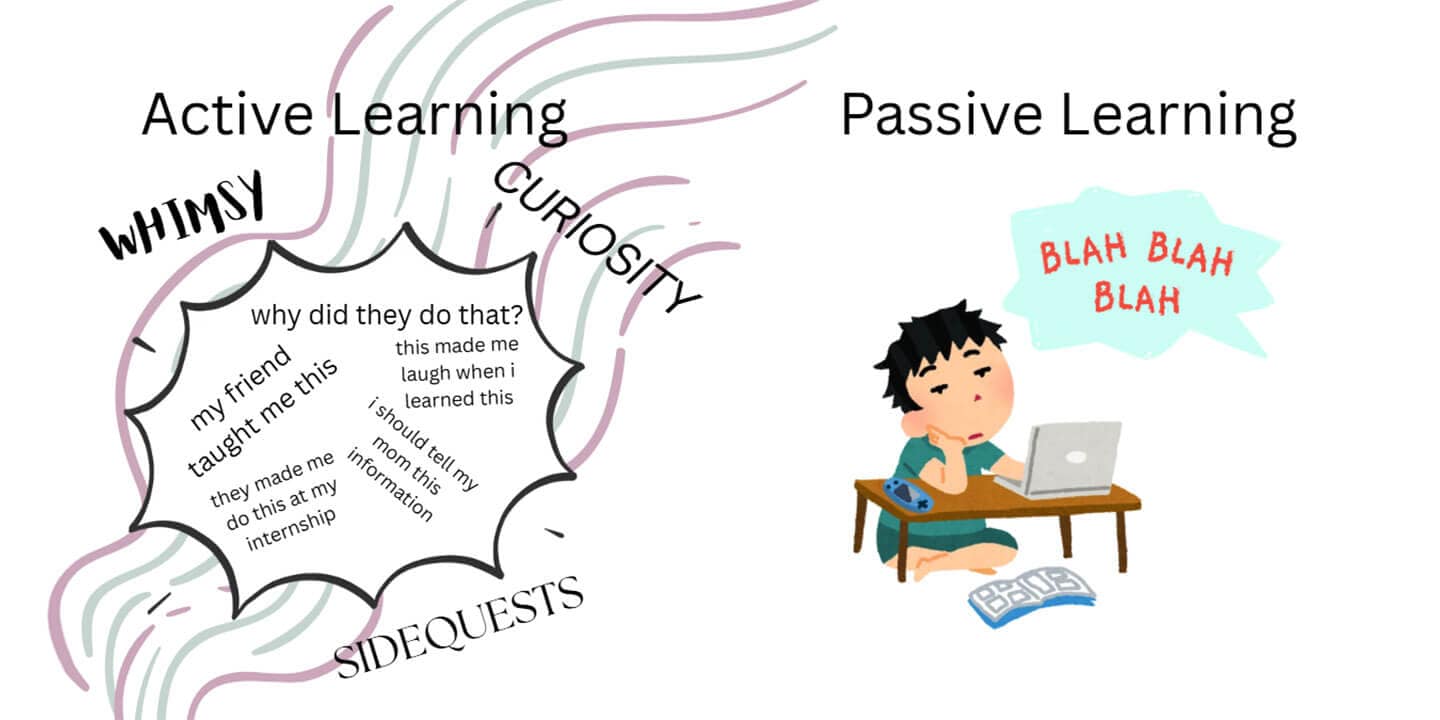
Active learning involves directly engaging with problems, while passive learning, like listening to a lecture, may not have an immediate application. Active learning is often preferred because it helps the brain create and strengthen connections, which improves memory retention.
According to neuroscientific research, this active engagement enhances synaptic plasticity, a key component of learning.1 This process allows you to engage directly with the material.
It’s almost like being a little kid figuring out how the world works for the first time. This is where curiosity comes in, prompting you to ask the questions you need to find the right answer.
Whimsy allows you to engage with the world on a deeper level, which can lead to new side quests. Once you've learned a subject in school, you will likely run into it in real life.
For example, I had a full-circle moment with my information systems class. Because I chose to apply for an internship with a "why not?" attitude, I was able to apply my knowledge in a real-life opportunity, helping the company improve how they collected survey information.
Final Thoughts
These three values—whimsy, curiosity, and side quests—have carried me through my academic career and kept me from burning out. How much curiosity and whimsy are in your life?
My final advice? Take more side quests!
1 Janet M. Dubinsky and Arif A. Hamid, "The Neuroscience of Active Learning and Direct Instruction," Neuroscience and Biobehavioral Reviews 163 (August 2024): 105737, https://doi.org/10.1016/j.neubiorev.2024.105737.
Do you have a compelling story or student success tips you’d like to see published on the Pearson Students blog? If you are a college student and interested in writing for us – click here to pitch your idea and get started!
About the author

Alexis Ele
Alexis Ele is a sophomore at the University of Nevada, Reno. She is a double major in psychology and nursing. She has a strong passion for mental healthcare and, as such, hopes to work as a psychiatric nurse practitioner after graduation. Outside of her academics, she loves to try new restaurants and play different sports and instruments, and she is currently working as a Pearson Campus Ambassador and an English Consultant.