Ch 02: Kinematics in One Dimension
Knight Calc - Physics for Scientists and Engineers 5th Edition
Knight Calc5th EditionPhysics for Scientists and EngineersISBN: 9780137344796Not the one you use?Change textbook
Chapter 2, Problem 35b

The vertical position of a particle is given by the function y = (t2 - 4t + 2) m, where t is in s. What is the particle's position at that time?

Verified step by step guidance
1
Identify the given function for the vertical position of the particle: y(t) = t^2 - 4t + 2, where y is in meters and t is in seconds.
To find the particle's position at a specific time, substitute the given value of t into the function y(t). For example, if t = t₀, calculate y(t₀) = (t₀)^2 - 4(t₀) + 2.
Simplify the expression by performing the operations: square the value of t₀, multiply 4 by t₀, and then add or subtract the terms as indicated.
Ensure the units are consistent. Since the function is in meters and seconds, the result will be in meters.
Verify the calculation by rechecking the substitution and simplification steps to ensure accuracy.

Verified video answer for a similar problem:

This video solution was recommended by our tutors as helpful for the problem above.
Video duration:
4m
Was this helpful?

Key Concepts

Here are the essential concepts you must grasp in order to answer the question correctly.

Kinematics

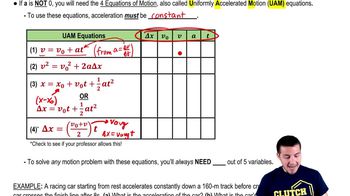
Kinematics is the branch of mechanics that describes the motion of objects without considering the forces that cause the motion. It involves concepts such as displacement, velocity, and acceleration, which are essential for analyzing the position of a particle over time. In this context, the function y = (t^2 - 4t + 2) m represents the vertical position of the particle as a function of time.
Recommended video:
Guided course
08:25
Kinematics Equations

Quadratic Functions

A quadratic function is a polynomial function of degree two, typically expressed in the form f(t) = at^2 + bt + c. The graph of a quadratic function is a parabola, which can open upwards or downwards depending on the sign of the coefficient 'a'. In the given equation, the quadratic nature indicates that the particle's vertical position changes in a non-linear manner over time.
Recommended video:
Guided course
5:13
Quadratic Equations

Evaluating Functions

Evaluating a function involves substituting a specific value into the function to determine its output. In this case, to find the particle's position at a given time 't', one must substitute the value of 't' into the function y = (t^2 - 4t + 2) m. This process is fundamental in mathematics and physics for determining specific outcomes based on defined relationships.
Recommended video:
Guided course
08:30
Intro to Wave Functions