What is the frequency of an electromagnetic wave that has the same wavelength as a 2.5 kHz sound wave in water?
Ch 16: Traveling Waves
Knight Calc5th EditionPhysics for Scientists and EngineersISBN: 9780137344796Not the one you use?Change textbook
Chapter 16, Problem 15
Show that the displacement D(x,t) = cx² + dt², where c and d are constants, is a solution to the wave equation. Then find an expression in terms of c and d for the wave speed.
Verified step by step guidance1
Step 1: Recall the wave equation, which is typically written as ∂²D/∂t² = v² ∂²D/∂x², where D(x,t) is the displacement, v is the wave speed, and ∂²D/∂t² and ∂²D/∂x² are the second partial derivatives of D with respect to time and position, respectively.
Step 2: Compute the second partial derivative of D(x,t) = cx² + dt² with respect to time (t). Since the term cx² does not depend on t, its derivative with respect to t is zero. For the term dt², the second derivative with respect to t is 2d.
Step 3: Compute the second partial derivative of D(x,t) = cx² + dt² with respect to position (x). Since the term dt² does not depend on x, its derivative with respect to x is zero. For the term cx², the second derivative with respect to x is 2c.
Step 4: Substitute the computed second derivatives into the wave equation ∂²D/∂t² = v² ∂²D/∂x². This gives 2d = v² * 2c. Simplify this equation to find the relationship between v, c, and d.
Step 5: Solve for the wave speed v in terms of c and d. From the equation 2d = v² * 2c, divide both sides by 2c to isolate v², yielding v² = d/c. Take the square root of both sides to find v = √(d/c).

Verified video answer for a similar problem:
This video solution was recommended by our tutors as helpful for the problem above.
Video duration:
3mWas this helpful?
Key Concepts
Here are the essential concepts you must grasp in order to answer the question correctly.
Wave Equation
The wave equation is a second-order partial differential equation that describes the propagation of waves through a medium. It is typically expressed as ∂²D/∂t² = v²∂²D/∂x², where D is the displacement, t is time, x is position, and v is the wave speed. Understanding this equation is crucial for analyzing wave behavior and determining if a given function, like D(x,t), satisfies the conditions of wave propagation.
Recommended video:
Guided course
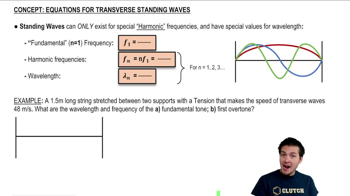
Equations for Transverse Standing Waves
Displacement Function
In the context of wave mechanics, the displacement function D(x,t) represents the position of points in a medium as a function of both space (x) and time (t). The form D(x,t) = cx² + dt² indicates that the displacement is a combination of spatial and temporal components, where c and d are constants. Analyzing this function helps in verifying if it meets the criteria set by the wave equation.
Recommended video:
Guided course
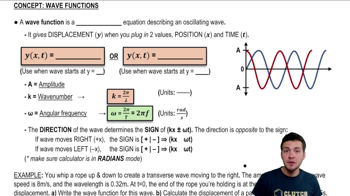
Intro to Wave Functions
Wave Speed
Wave speed is the rate at which a wave propagates through a medium and is denoted by v in the wave equation. It can be derived from the relationship between the second derivatives of the displacement function with respect to time and space. In this case, finding the wave speed involves substituting the displacement function into the wave equation and solving for v in terms of the constants c and d.
Recommended video:
Guided course
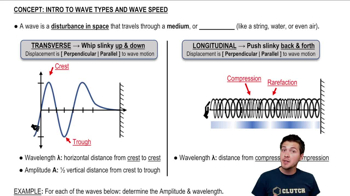
Intro to Waves and Wave Speed
Related Practice
Textbook Question
472
views
Textbook Question
Show that the displacement D(x,t) = ln(ax + bt), where a and b are constants, is a solution to the wave equation. Then find an expression in terms of a and b for the wave speed.
1682
views
Textbook Question
A hammer taps on the end of a 4.00-m-long metal bar at room temperature. A microphone at the other end of the bar picks up two pulses of sound, one that travels through the metal and one that travels through the air. The pulses are separated in time by 9.00 ms. What is the speed of sound in this metal?
1796
views
Textbook Question
The wave speed on a string under tension is 200 m/s. What is the speed if the tension is halved?
2172
views
Textbook Question
FIGURE EX16.8 is a picture at t = 0 s of the particles in a medium as a longitudinal wave is passing through. The equilibrium spacing between the particles is 1.0 cm. Draw the snapshot graph D(x, t = 0 s) of this wave at t = 0 s.
2055
views
Textbook Question
Draw the history graph D(x = 4.0 m, t) at x = 4.0 m for the wave shown in FIGURE EX16.4.
2760
views